Pulse
A Week of Mixed Signals
From rising oil prices and fuel relief to interest rates, reserves, the IMF review and a volatile stock market, here’s your quick look at the economic stories shaping Pakistan this week.
Another Week, Another Pulse!
Pakistan is sitting on record foreign exchange reserves, but your petrol bill, grocery budget and electricity costs are still under pressure. And just as the government rolls out fuel relief, rising oil prices and fresh Middle East tensions are making the economic outlook harder to predict.
Here's what happened this week, what's behind the headlines, and what to keep an eye on as we head into a new one.
The Middle East is keeping the world on edge. And oil is feeling it.
The conflict involving Iran and its regional rivals continued to raise concerns about global energy supplies. Yemen's Houthis claimed attacks on sensitive sites in Riyadh using missiles and drones, following reports of flames and smoke near the Saudi capital's main airport. Saudi authorities had also issued overnight warnings about potential danger around the city.
Iran added to the uncertainty, warning that any major new attack by the US and its allies would trigger sustained retaliation against American bases and interests. It also said Washington's regional allies could be considered parties to the conflict.
The uncertainty is now spilling into oil markets. JPMorgan said it no longer had a clear baseline outlook for oil prices as the conflict entered its sixth month, with supply risks mounting across the Middle East and other major oil-producing regions.
Why Pakistan should care: We import oil, so trouble in the region can quickly become trouble at home. Higher oil prices can mean more expensive petrol, transport and electricity, with the impact eventually reaching everyday essentials.
And that brings us to Pakistan's biggest household concern this week: the rising cost of living.
Fuel relief is here. But will it be enough?
Pakistan's weekly inflation climbed back into double digits, reaching 10.64% for the week ended September 17. Rising fuel prices, amid the Middle East situation, added to the pressure on household budgets.
The government responded with a Rs75 billion fuel relief package for three months, targeting motorcyclists and small car owners.
The scheme has also been revised to include more two- and three-wheelers, ease weekly usage limits and remove SMS charges. The changes are intended to make the support more accessible, particularly for motorcycle, rickshaw and Qingqi users.
But the relief comes with a catch: it's temporary. And the pressure on fuel prices hasn't disappeared.
Federal Petroleum Minister Ali Pervaiz Malik warned that petrol could cost as much as Rs1,000 per litre if a shortage develops in the country.
That is a warning about a possible shortage scenario, not an announced petrol price.
The bigger picture: Fuel subsidies may offer some breathing room, but they cannot shield households from every increase in energy and transport costs. With inflation back in double digits, the coming weeks will show how much relief consumers actually feel.
No interest rate cut. Here's what that means for your money.
If you were expecting borrowing costs to come down, the State Bank of Pakistan had other plans.
The SBP kept its policy rate unchanged at 11.5%, with seven out of 10 Monetary Policy Committee members voting to hold.
The decision came as rising geopolitical tensions pushed up global commodity prices and added uncertainty to Pakistan's inflation outlook.
For borrowers, that means no immediate policy-driven reduction in borrowing costs. For savers and investors, the existing interest rate environment remains in place for now.
But here's the connection: fuel prices, inflation and interest rates are all part of the same story. If energy prices keep rising and inflation remains under pressure, the SBP may have less room to cut rates.
What to watch: Whether oil prices stabilize, inflation eases and the next economic data gives the SBP more clarity.
Pakistan has more dollars in the bank. Is that enough to breathe easily?
There's some encouraging news on Pakistan's external finances.
Foreign exchange reserves reached $26.8 billion as of September 11, the highest combined level since September 2021.
The breakdown:
SBP reserves: $21.4 billion, a record for the central bank.
Commercial bank reserves: $5.4 billion.
Pakistan's current account deficit also narrowed. The country recorded a $543 million deficit during the first two months of FY27, down 36% from $853 million in the same period last year, supported by strong remittance inflows.
August offered another positive signal. The current account deficit fell to $98 million, compared with $445 million in July and $342 million in August last year. If the trend continues, Pakistan could record a current account surplus in September.
But don't celebrate just yet.
The trade gap is widening, oil prices are rising, and profits and dividends sent abroad by foreign investors fell 13.4% during the first two months of FY27 compared with the same period last year.
So what's the takeaway? Pakistan's external position has improved, but higher reserves alone don't mean the pressure is gone. The country's ability to manage imports, exports, remittances and energy costs will remain important.
The IMF is coming back. And Pakistan's energy sector is under the spotlight.
An IMF delegation is scheduled to visit Pakistan on September 23 for the next review under the ongoing programme.
The visit comes at a time when Pakistan is managing higher energy costs, inflationary pressure and uncertainty around the global economy.
Meanwhile, the government has approved a draft upgrade agreement under the Pakistan Oil Refining Policy 2023, as amended in August 2026. The agreement is aimed at supporting major investments in existing and brownfield oil refineries.
The two developments are connected by a bigger question: how does Pakistan strengthen its economy while managing the cost of energy?
Refinery investment is a longer-term effort, while the IMF review will be an immediate development to watch.
Electricity bills, supplier choice and a virtual grid. What's changing?
Electricity costs remain another concern for households and businesses.
Consumers across Pakistan may face a Rs1.73 per-unit increase following a request for an adjustment under the monthly fuel price adjustment mechanism for August. The increase is not yet a confirmed final tariff.
At the same time, the government is pushing for changes to how electricity is bought and supplied.
Power Minister Awais Leghari said businesses and industries would be allowed to choose their electricity suppliers under a new competitive system, rather than being forced to buy electricity at government-set rates.
The government is also working on a virtual grid system that would allow consumers to generate and store electricity.
These changes could give businesses more flexibility in managing their energy needs, but the actual impact will depend on how the systems are implemented.
For now: Electricity costs remain a near-term concern, while supplier choice and energy storage are developments to follow over the longer term.
Cars, factories, sugar and digital finance: The business stories you may have missed
Not every economic story this week was about oil, inflation or interest rates. Here's what else happened across Pakistan's business landscape.
Factories are growing, but only modestly.
Large-scale manufacturing grew 3.03% year-on-year in July, the first month of FY27. Month-on-month growth was stronger at 9.5%.
Car sales are slowing, but car loans keep climbing.
Traditional automakers sold 15,558 vehicles in August, up 11% year-on-year but down 21% from July. Competition from new energy vehicles was cited as a key factor.
Despite the monthly decline in sales, outstanding car loans rose for the 21st consecutive month, reaching Rs393.3 billion in August, compared with Rs386.3 billion in July.
Sugar mills want to export their surplus. The Pakistan Sugar Mills Association has demanded permission to export at least one million tonnes of sugar. The association warned that delays in clearing the surplus could force mills to postpone the start of the 2026–27 crushing season.
Small businesses get a new digital financing option.
The Securities and Exchange Commission of Pakistan approved a Shariah-compliant digital financing facility that will allow small businesses to obtain up to Rs3 million through a digital app.
US crypto legislation hits a roadblock. A major push for cryptocurrency legislation in the United States stalled after Republicans and Democrats failed to agree on ethics, banking and how the industry should be regulated.
Google's partnership with Pakistan faces questions over privacy. Media watchdog Freedom Network has written an open letter to Google and the government seeking clarity on safeguards surrounding Google's recent partnership with Pakistan. The group raised concerns about potential surveillance, censorship and access to citizens' personal information.
📅 Key Events to Watch!
📆 September 24, 2026💵 Foreign Exchange Reserves Update
📆 September 25, 2026🛒 Weekly Sensitive Price Index (SPI) Release
Note: These dates are tentative and subject to change. Credits: Pulse by Capital Stake
STOCK MARKET
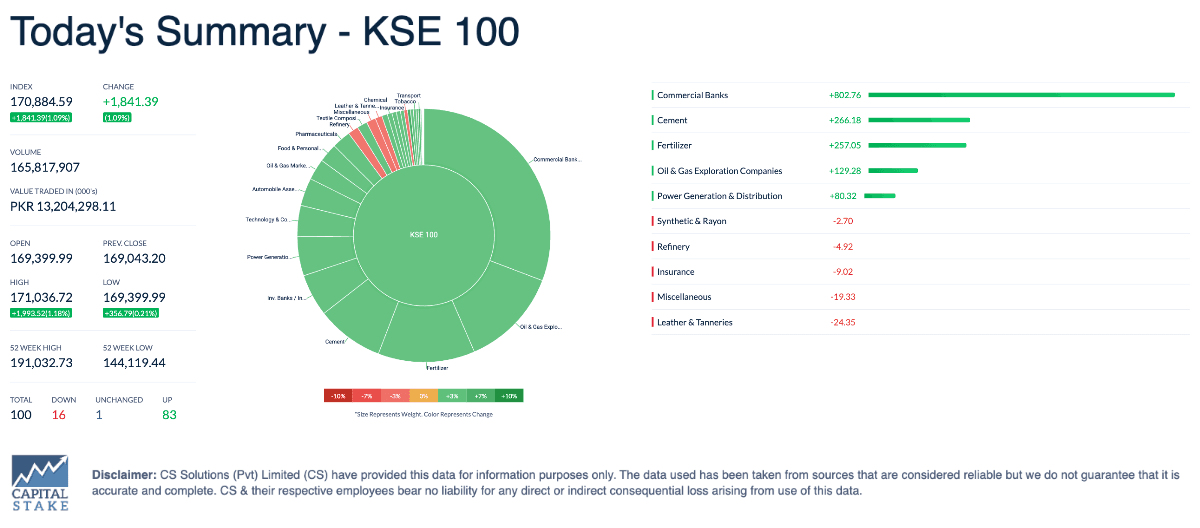
It was a week of uncertainty at the Pakistan Stock Exchange, but the KSE-100 Index managed to finish in positive territory. After spending much of the week under pressure from geopolitical tensions, hopes of diplomatic talks ahead of the UN General Assembly session helped lift investor sentiment. The index closed at 170,885 points, up 0.22% for the week.
Credits: StockIntel
FUNDS IN VIEW
Fund Ranking 🏆
Top 5 Income and Money Market Funds this Week!
JS Microfinance Sector Fund from JS Investments leads at 11.96%, and Meezan Govt. Securities Fund Plan I from Al Meezan Investment Management Limited holds the top Shariah-compliant spot at 11.79%.
Compare the returns before you invest.

Full list at https://lnkd.in/d8kTeWfv
Before you go: What to watch next week
Three developments could shape the conversation in the days ahead:
September 23: IMF review. The delegation's visit will be an important development for Pakistan's economic outlook.
Oil prices and the Middle East. Any further escalation could affect fuel costs, inflation and Pakistan's external finances.
Inflation and electricity costs. With inflation back in double digits and a possible power tariff adjustment on the table, household expenses remain under pressure.
Pakistan's economic picture is a mixed one. Reserves are at a multi-year high, the current account deficit has narrowed, and new financing and energy initiatives are moving forward. But higher oil prices, inflation and electricity costs mean the pressure on households and businesses is far from over.
The numbers are worth watching. What they mean for your money is what matters.
See you next week for another Pulse!