
Pulse
📊 Geopolitics 🏛️ Budget 📈 Markets 📊
A week of heightened uncertainty saw global geopolitical tensions and rising inflation weigh on Pakistan’s economy, keeping markets cautious and growth under pressure. With the PSX range-bound and economic indicators mixed, all eyes now turn to the upcoming federal budget for direction and potential relief.
Another Week, Another Pulse!
If there was one word that defined the week, it was uncertainty.
Markets entered the week focused on two things: the upcoming federal budget and the increasingly complicated geopolitical situation in the Middle East. Neither provided much clarity. Peace talks between the United States and Iran remain stuck, military activity in the region continues, and investors are still trying to gauge whether the conflict evolves into a prolonged standoff or moves toward a negotiated settlement.
President Donald Trump reiterated that US forces would remain engaged until there is a "completion" of the conflict and indicated he would even consider military involvement to secure Iran's nuclear stockpile if required. Meanwhile, Iranian officials continue to accuse Washington of shifting positions during negotiations. For financial markets, the result is straightforward: elevated uncertainty, volatile energy prices, and increased caution across global risk assets.
Oil remained the center of attention throughout the week. While OPEC+ announced yet another increase in production targets, geopolitical concerns continued to overshadow supply-side developments. The market's message was clear: production targets matter, but geopolitical risk premiums matter more.
Pakistan is already beginning to feel the impact.
Inflation climbed to 11.7% in May, its highest reading since June 2024, while short-term inflation surged even further to 14.75%. Rising energy costs, food prices, and imported inflation continue to squeeze household budgets. Consumers are becoming increasingly selective with spending, and businesses are finding it harder to pass on higher costs without impacting demand.
There was, however, a rare piece of positive news for consumers. The government reduced petrol prices by Rs4 per litre during the week, while keeping diesel prices unchanged.
That pressure is visible across multiple sectors. Oil marketing companies reported their sharpest monthly decline in sales since November 2023 as higher fuel prices forced consumers to limit travel and discretionary spending. Cement dispatches fell more than 21% year-on-year, reflecting a slowdown in construction activity and investment appetite. Even business sentiment continues to weaken, with the latest OICCI survey showing that nearly 70-80% of businesses are delaying, reconsidering, or postponing new investment decisions altogether.
Against this backdrop, all eyes have turned toward the federal budget.
The government has set an exchange rate assumption of Rs290 per dollar for the upcoming fiscal year, implying only modest depreciation and signaling confidence in meeting external financing obligations. At the same time, policymakers are targeting 4% GDP growth for FY2026-27 despite ongoing geopolitical uncertainty, elevated oil prices, and a challenging global environment.
Reports suggest budget makers are evaluating a lower-rate transaction tax on stock market trades, a move that would be welcomed by investors and could improve market liquidity. Simultaneously, the government is expected to announce tariff relief on industrial raw materials and imported inputs, providing some support to domestic manufacturers struggling with high production costs.
However, expectations of broad-based tax relief appear to be fading. Discussions with the IMF indicate that any meaningful concessions may largely be limited to the salaried class, while businesses and multiple sectors are unlikely to receive significant relief. Adding to concerns, GST on everyday school and office supplies could rise from 10% to 18%, highlighting the difficult balancing act between revenue generation and inflation management.
Tax administration itself is also undergoing a transformation.
Following the underwhelming results of the Tajir Dost Scheme, authorities have unveiled the Fixed Tax Asaan Scheme for small traders and shopkeepers with annual turnover of up to Rs200 million. More importantly, the government has approved in principle a centralized digital tax operating model where audits and assessments would be conducted through faceless systems in Islamabad, reducing direct interaction between taxpayers and tax officials and potentially improving transparency.
Pakistan's external account presented a mixed picture during the week. The trade deficit narrowed sharply in May as imports declined and exports improved on a month-on-month basis. Yet the broader trend remains less encouraging, with exports contracting during the first eleven months of the fiscal year while the overall trade deficit widened. Further uncertainty emerged from the United States, where proposed trade duties targeting 60 countries, including Pakistan, could create additional challenges for exporters if implemented.
Amid these headwinds, there were still pockets of optimism.
The Securities and Exchange Commission of Pakistan relaxed IPO requirements, making it easier for established businesses to raise capital through the Pakistan Stock Exchange.
The country's long-term investment story also received support from continued progress on strategic projects. Security arrangements for the Reko Diq Copper-Gold Project are being enhanced amid regional tensions, underscoring the project's growing importance to Pakistan's economic future. Meanwhile, Saudi Arabia is exploring the establishment of a crypto and blockchain zone in Karachi, potentially opening new avenues for technology investment and digital innovation.
On the consumer front, competing realities are beginning to emerge. The Pakistan Institute of Development Economics has recommended raising the minimum wage by at least 12.5% to Rs45,000, while government employees are demanding substantial increases in salaries and allowances. Whether the government can accommodate these demands without adding further pressure to inflation and public finances remains one of the key questions heading into budget week.
Gold investors experienced a reminder that markets rarely move in a straight line. After weeks of strength driven by geopolitical concerns, local gold prices fell sharply, declining by more than Rs12,000 per tola in a single session as international prices retreated. The correction highlights the volatility that often accompanies periods of heightened uncertainty.
As we enter budget week, investors are searching for direction, businesses are looking for confidence, and consumers are hoping for relief.
The coming days may not answer every question, but they will likely define the economic conversation for the rest of the year.
📅 Key Events This Week
📌 9 June 2026 📊 Economic Survey of Pakistan
📌 10 June 2026 🏛️ Federal Budget Announcement
📌 11 June 2026
💱 Foreign Exchange Reserves Update
📌 12 June 2026
📊 Weekly SPI Inflation Data Release
Credits: Pulse by Capital Stake
STOCK MARKET
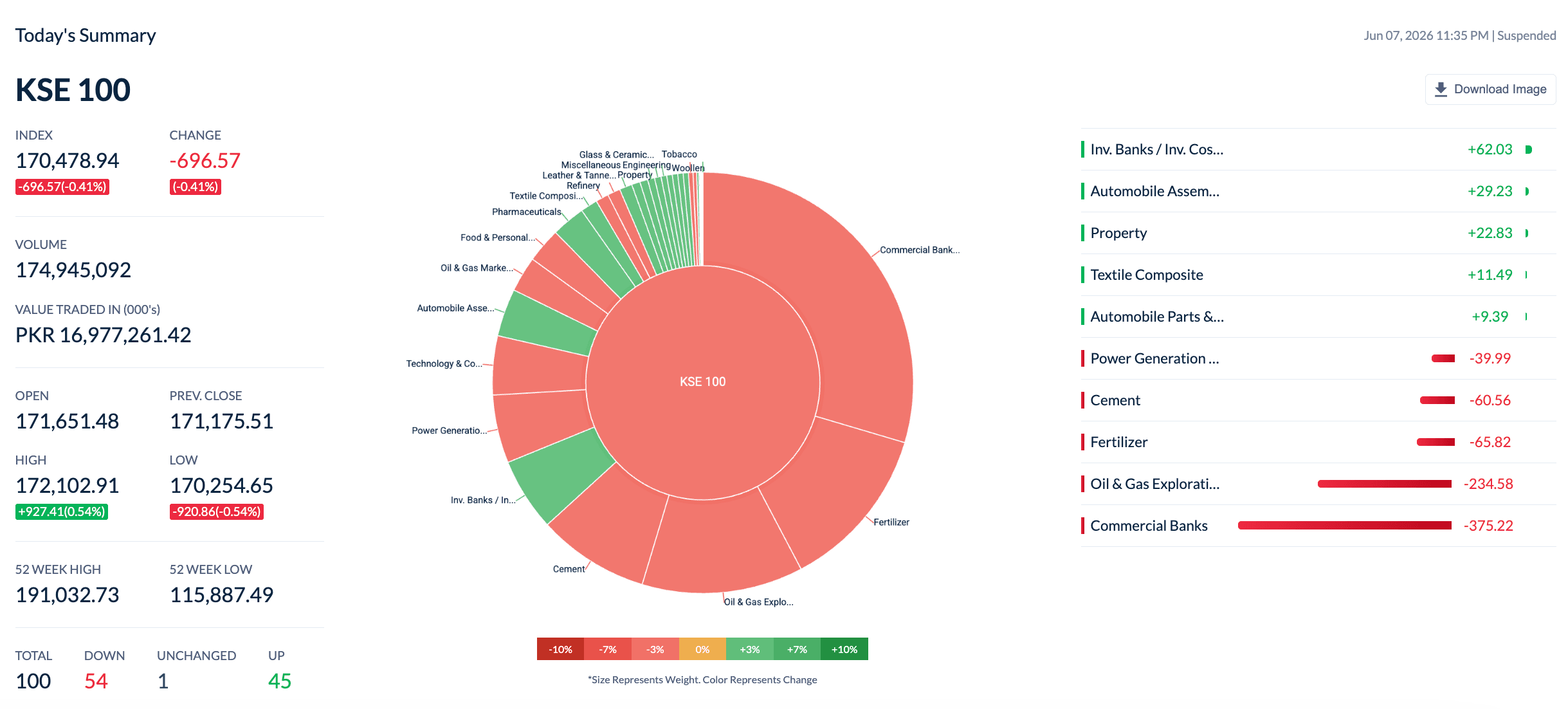
The Pakistan Stock Exchange (PSX) remained largely range-bound and cautious throughout the week as prolonged uncertainty over US–Iran peace talks kept sentiment subdued. The KSE-100 index delivered a flat to negative performance, closing at 170,479, down 2% week-on-week (-3,484 points), as lack of tangible progress in negotiations continued to weigh on investor appetite and keep trading activity directionless.
Credits: StockIntel
Gul Ahmed announces $230m data centre
Gul Ahmed’s Quantum Global Data Centre (QGDC) has announced a $230 million investment to build Pakistan’s largest Tier III data centre, with total investment potentially reaching $600 million. Developed in partnership with Huawei Pakistan and targeted for completion by 2027, the project aims to strengthen Pakistan’s digital infrastructure amid rising demand for cloud and data services, potentially positioning the country more competitively in the regional tech ecosystem.
FUNDS IN VIEW
🏆 AUM Leaderboard – April 2026! 📊
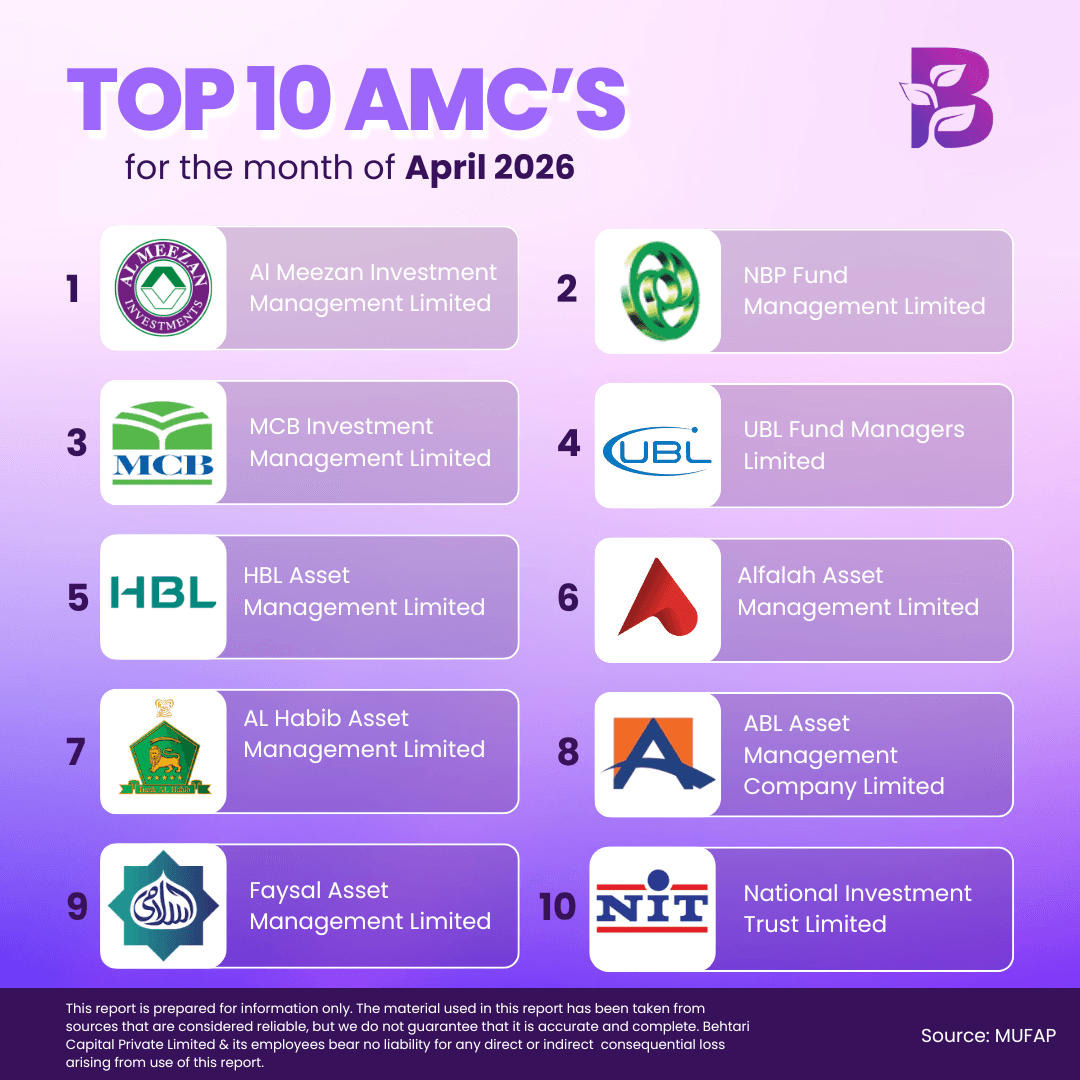
Who made it to the Top 10 AMCs this month?
The powerhouse trio - Al Meezan Investment Management Limited, NBP Fund Management Limited, and MCB Funds continue to dominate the top 3, proving their long-term stability in the market yet again. 🏛️✨
🔥 What’s New This Month? The leaderboard is heating up with a competitive shuffle in the top 5:
🚀 HBL Asset Management Limited showed incredible momentum, climbing up to secure the 5th position! 🔹 Alfalah Investments follows closely, holding strong in the 6th spot after a highly competitive month.
Credits: Behtari
Check out more details on: https://lnkd.in/dZcUXDmH