
Pulse
IMF, Inflation and Oil
Inflation, oil prices and tougher IMF talks kept Pakistan's economy under pressure, while higher government yields gave savers more options. We also look at the PSX's difficult week, Pakistan's mixed economic numbers, and Khaadi's upcoming IPO.
Another Week, Another Pulse!
It was a week of expensive problems. Inflation crossed 11%, oil remained under pressure, IMF talks got tougher, and the government started paying more to borrow.
And the new week isn't bringing much relief.
📅 Key Events to Watch!
📆 October 7, 2026
💵 Foreign Exchange Reserves Update
📆 October 8, 2026
🛒 Weekly Sensitive Price Index (SPI) Release
Note: These dates are tentative and subject to change. Credits: Pulse by Capital Stake
Oil, War and Your Monthly Budget
The Middle East conflict is no longer just a geopolitical story. It is becoming an economic one.
Pakistan's weekly inflation rose 11.53% year-on-year, while September's inflation came in at 10.3%. Food prices have eased, but higher energy costs are keeping pressure on household budgets.
And the situation could get worse before it gets better.
Saudi-backed Yemeni forces have launched a major operation against the Iran-backed Houthis, while Saudi Arabia, Türkiye and Pakistan are preparing for talks in Riyadh.
For Pakistan, the concern is simple: the longer the regional conflict keeps oil prices elevated, the harder it becomes to bring inflation down.
The IMF Wants Answers
Pakistan's IMF review has entered a crucial stage.
The IMF has now shared the first draft of the Memorandum of Financial and Economic Policies, bringing the talks closer to a possible Staff-Level Agreement.
But there is still plenty to negotiate.
The IMF has raised concerns over energy-sector circular debt, subsidies, delayed structural reforms and other commitments under the programme. It is also pushing Pakistan to replace broad electricity subsidies with more targeted support for lower-income households.
The IMF mission is expected to remain in Islamabad into next week.
So this week, all eyes are on one thing: can both sides close the remaining gaps and get to a deal?
Government Borrowing Gets More Expensive
Pakistan needs money to finance its budget, and the price of borrowing is going up.
The government plans to borrow another Rs6.86 trillion this financial year, while Treasury Bill yields were raised by as much as 75 basis points last week.
For the average saver, this may sound like government business. It isn't.
When government securities offer higher returns, they become tougher competition for other investments.
The government is also planning to allow the public to trade government securities through the stock market, potentially making them easier to access.
For investors, the question is becoming harder to ignore: where does your money get the best risk-adjusted return?
Inflation Isn't Going Away Yet
September's inflation slowed from August, but at 10.3%, it is still well above the SBP's FY27 target of 5–7%.
Analysts now expect the central bank to miss that target, largely because of continued pressure from energy prices.
The IMF is also pushing Pakistan to use targeted subsidies rather than broad subsidies to protect lower-income households from the impact of the energy shock.
For anyone keeping money in cash, the issue remains the same: when prices rise this quickly, money sitting idle loses purchasing power.
Pakistan's Numbers Are Sending Mixed Signals
There was some good news last week.
Pakistan's total liquid foreign reserves reached $26.8 billion as of September 25. The FBR also collected Rs3.083 trillion in the first quarter of FY27, beating its target by Rs30 billion.
But the trade picture is less encouraging.
Pakistan's trade deficit reached $10.8 billion during the first quarter, up by $1.4 billion, as imports grew faster than exports.
And another concern is emerging as the Rabi season begins: Pakistan is facing an expected 25% water shortage, raising concerns about wheat production and food security.
So the economy isn't moving in one clear direction. Some numbers are improving while others are becoming harder to ignore.
A Few More Things Happened
The government is tightening its approach to taxation.
The FBR extended the deadline for filing income tax returns for 2026 to October 15, giving taxpayers additional time after the original September 30 deadline.
The government also announced that it would start mapping shops that have not joined the fixed-tax scheme, which offers eligible traders a 1% tax rate in exchange for staying outside the audit process and being able to deal in cash.
Meanwhile, the SECP has proposed raising the maximum microfinance and housing loan limit to Rs5 million, while also increasing the income threshold for individual borrowers.
The World Bank is pushing Pakistan to move faster on reforms around taxation, regulation, trade and investment.
And there were some positive signs from industry: domestic cement dispatches rose 7.35% year-on-year in September, while urea sales were up 43% year-on-year, although September sales were lower than August.
What We're Watching This Week
- IMF talks: Can Pakistan and the IMF agree on the remaining issues and move towards a Staff-Level Agreement?
- Oil and the Middle East: Does the conflict put further pressure on energy prices?
- Inflation: Can Pakistan prevent the latest energy shock from pushing prices even higher?
- Government yields: With Treasury Bill returns moving up, will savers and investors shift more money towards government securities?
- Agriculture: How serious will the expected water shortage be for the Rabi season and wheat production?
The Big Picture?
Pakistan is trying to keep inflation under control, secure its IMF programme and manage rising energy costs, all while borrowing more to fund the economy.
For savers and investors, that makes the weeks ahead worth watching closely.
STOCK MARKET
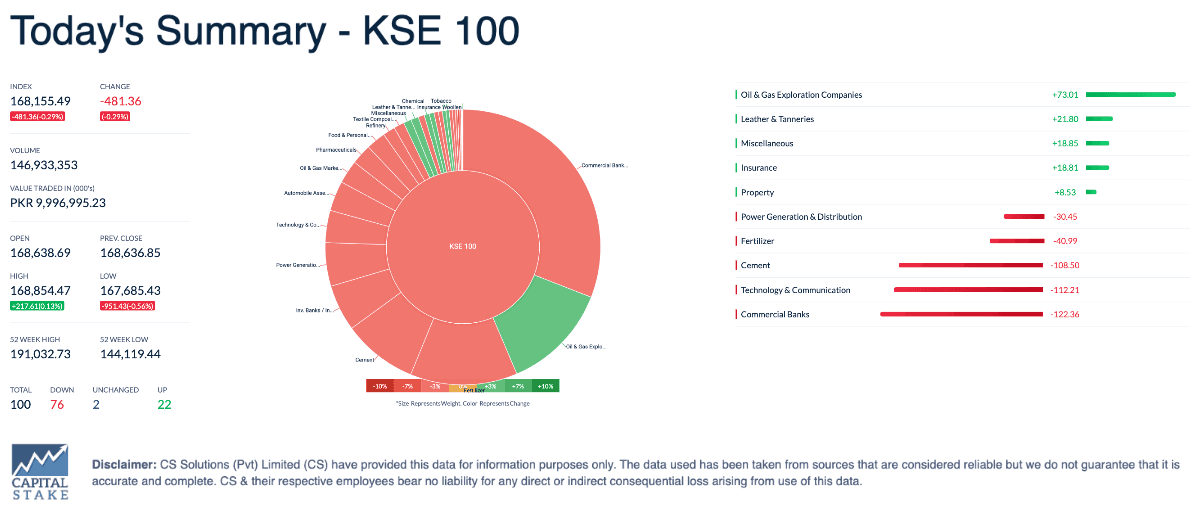
The PSX had a week to forget, with the KSE-100 dropping 1.5% as investors stayed cautious amid regional tensions, expensive oil and uncertainty around the US-Iran situation.
The index fell below 170,000, while trading activity also slowed noticeably. Investors remained on the sidelines as a wider trade gap and rising T-bill yields added to the uncertainty.
There was one small positive: September inflation eased to 10.3%, down from 11.1% in August.
This week, the market's direction could depend heavily on what happens with oil, the IMF talks and the broader regional situation.
Credits: StockIntel
Khaadi to List on PSX
Khaadi is preparing to list on the PSX next month, aiming to raise up to Rs8.3 billion through a pre-IPO placement and public share offering. The money will help fund the company's expansion, including new stores and investments from 2027 onward. For investors, this is another well-known consumer brand entering the stock market, giving them a chance to own a piece of a business they already know. Next, investors will be watching the IPO pricing, share offer and how much demand the listing attracts.