Pulse
🛢️ Oil 🏛️ Policy 📉 Markets

A sharp look at the week that moved markets, shaped policy, and influenced the economic outlook — from budget decisions and fuel prices to global tensions, digital payments, and the trends investors should be watching next.
Another Week, Another Pulse!
Just when everyone thought the long weekend would slow things down, the world decided otherwise. Global tensions shot up dramatically after Iran reportedly launched missile and drone attacks on US-linked military targets in Bahrain and Kuwait following American strikes on Iranian sites. While a ceasefire technically still exists, markets around the world are now watching the Middle East very carefully because any instability there directly affects oil prices, trade routes, and investor confidence — including here in Pakistan.
Back home, Karachi saw another grim reminder of the country’s security challenges after heavily armed attackers stormed a security compound, resulting in the deaths of at least three paramilitary personnel. Security concerns remain one of the biggest factors influencing investor sentiment and business confidence in the country.
The government also formally cleared the Budget 2026-27 this week, pushing it through the National Assembly despite opposition protests and a walkout during proceedings. The new budget introduces a series of tax and policy adjustments that are expected to shape business activity over the coming year. Advance taxes on property transactions have been revised, banks and corporate entities are facing additional tax pressure, while the government simultaneously moved ahead with plans to gradually reduce import duties under the proposed National Tariff Policy 2025-30 in an attempt to lower trade costs and improve competitiveness.
One of the more notable developments came for export-oriented industries. The government approved the removal of Super Tax for companies generating more than 80% of their turnover through exports, providing a significant boost for sectors such as textiles, which have spent the past year battling weak demand, high energy costs, and margin pressure.
Pakistan’s digital payments ecosystem, meanwhile, continued to expand at an impressive pace. According to the State Bank’s Quarterly Payment Systems Review, retail digital payments reached 3.7 billion transactions during the January-March 2026 quarter, up 9% from the previous quarter. Mobile app-based transactions alone accounted for nearly 78% of all digital payments, highlighting how rapidly consumer behavior continues to shift toward digital banking, wallets, and online commerce.
The State Bank also released its calendar for Monetary Policy Committee meetings for FY27, setting the stage for what is expected to be another closely watched year for interest rate decisions as inflation, government borrowing, and oil prices remain firmly in focus.
And on the subject of borrowing — the government borrowed over Rs. 4.9 trillion from commercial banks during the first eleven and a half months of FY26, surpassing borrowing during the same period last year despite a sharp increase in tax collection over recent years. The figures underline the government’s continued reliance on domestic financing to manage fiscal pressures.
Energy remained one of the week’s biggest talking points. Despite lower international oil prices, petrol and diesel prices locally remained unchanged at Rs. 299.50 and Rs. 311.47 per litre respectively, as the government chose to absorb the benefit through higher petroleum levies instead of passing relief on to consumers. At the same time, the Petroleum Division assured oil marketing companies and refineries that future pricing adjustments would better reflect actual import premiums following concerns raised by the sector.
Gold prices continued their downward trend during the week in line with softer international markets, while Pakistan’s gold imports also declined sharply during the fiscal year, reflecting weaker domestic demand and changing consumer spending patterns.
Global cryptocurrency markets, however, continued to struggle. The sector has now erased more than half of its total market value over the past eight months, extending one of the steepest corrections the industry has seen in recent years as investors continue moving away from high-risk assets.
There was, however, some improvement in international investor sentiment toward Pakistan. Barclays upgraded Pakistan’s dollar bonds to “overweight” after previously lowering its rating, citing improved oil market prospects and stabilizing external conditions. Separately, Bloomberg Philanthropies announced a $285 million global commitment toward renewable energy initiatives, a sector Pakistan continues to push toward as energy affordability and sustainability remain long-term economic concerns.
Pakistan’s trade and logistics sector also saw encouraging momentum this week. Karachi Gateway Terminal announced plans to invest up to $100 million over the next five years as Pakistan attempts to capitalize on shifting regional cargo flows and strengthen its position as a regional shipping and logistics hub.
Meanwhile, consumers planning to upgrade their tech devices may need to brace for higher prices. Apple has increased prices across several MacBook and iPad models globally due to rising semiconductor costs, with the impact expected to flow directly into the Pakistani market over the coming weeks.
As the new fiscal year begins, attention now shifts toward how markets, businesses, and consumers respond to the newly approved budget measures. At the same time, developments in the Middle East, movements in global oil prices, and the State Bank’s monetary policy direction are likely to remain the key themes driving both markets and sentiment in the weeks ahead.
📅 Key Events This Week!
📆 July 1, 2026📈 CPI Inflation Data Release
📆 July 2, 2026💵 Foreign Exchange Reserves Update
📆 July 3, 2026🛒 Weekly Sensitive Price Index (SPI) Release
Note: These dates are tentative and subject to change. Credits: Pulse by Capital Stake
🔄 Key Changes in the Approved FY2026-27 Budget (Updated after final approval and Standing Committee revisions)
📱 Digital, Tax & Compliance
- 📌 PTA/imported mobile phone taxes remain unchanged, but instalment payment facility introduced
- 📌 Proposed FBR power to share taxpayer sales data with businesses removed
- 📌 Social media earnings to continue facing 5% withholding tax
- 📌 Penalty for non-integration with FBR systems reduced from 5% to 3% of expenditure
- 📌 Taxpayers can now object to FBR-appointed external auditors within 15 days
- 📌 Some proposed penalties and liabilities on company officers withdrawn
💼 Business & Export Relief
- 📌 Export-oriented businesses exempted from Super Tax where exports exceed 80% of turnover
- 📌 IT exporters’ preferential tax regime extended till 2029
- 📌 Exporters’ tax reduction from 2% to 1.25% retained
- 📌 Tax exemptions introduced for qualifying private equity and venture capital funds
- 📌 Reduced minimum tax regime expanded to more FMCG sectors including food, dairy, cosmetics and cleaning products
🏠 Property & Financial Relief
- 📌 Property tax reductions retained, including lower advance tax on purchases and sales
- 📌 Section 7E deemed property income tax abolished
- 📌 Capital Value Tax on financial assets abolished
- 📌 Foreign debit and credit card transaction tax reduced from 5% to 0.5%
🚗 Vehicles & EVs
- 📌 Luxury EV taxation shifted to dollar-based thresholds
- 📌 EVs up to $75,000 customs value remain exempt from FED
- 📌 Duties on imported vehicles above 2000cc increased sharply to 86%–92%
🛒 Sales Tax & Consumer Measures
- 📌 Sanitary pads, tampons and contraceptives remain exempt from sales tax
- 📌 Wheat bran and rice bran added to sales tax exemption list
- 📌 Insecticides and disinfectants removed from proposed higher-tax retail schedule
- 📌 Footwear manufacturers selling only through digitally integrated POS outlets granted relief
🏭 Industrial & Sectoral Changes
- 📌 White spirit and solvent oil used in manufacturing exempted from proposed FED under conditions
- 📌 Aircraft import tax exemptions extended to all Pakistan-registered airlines from July 2027
- 📌 Reduced tax introduced for imported coal supplied directly to IPPs
⚠️ Penalties & Enforcement
- 📌 Failure to install mandatory electronic systems may trigger penalties up to 1% of turnover
- 📌 Late-filing penalties revised based on previous year’s tax payable
- 📌 Customs penalty increase reduced from Rs. 10 million to Rs. 5 million
Source
STOCK MARKET
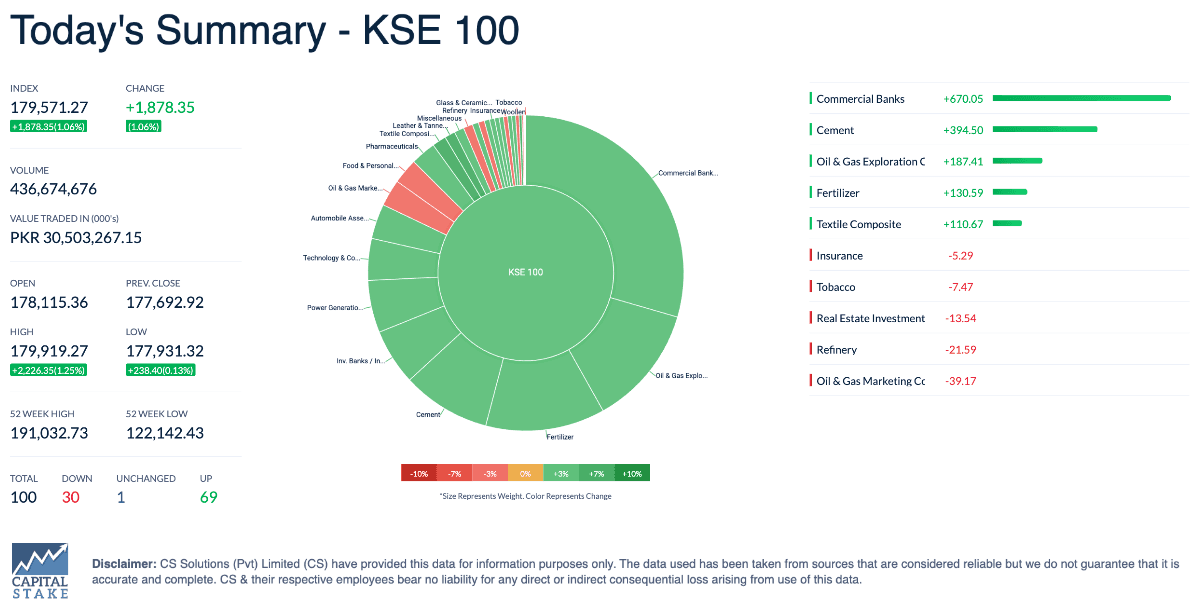
The Pakistan Stock Exchange (PSX) remained resilient during the shortened three-day trading week, with the benchmark KSE-100 Index settling at 179,571 points, reflecting a weekly gain of 649 points or 0.36%. Investor confidence improved following the approval of the FY27 budget and easing geopolitical concerns, which supported positive market momentum throughout the week. Despite rollover pressure, market sentiment stayed optimistic as investors responded positively to improving regional stability and policy clarity.
Credits: StockIntel
Tasdeeq set for Pakistan Stock Exchange debut
Tasdeeq, a leading SBP-regulated credit information and analytics company, has announced plans to launch an IPO on the Pakistan Stock Exchange (PSX), making it the first publicly listed credit bureau in South Asia. The listing is significant as it highlights growing investor interest in Pakistan’s financial technology and data analytics sector while also improving visibility and transparency in the credit information industry. Going forward, the IPO could pave the way for greater private-sector participation in Pakistan’s fintech ecosystem and may encourage other technology-driven financial institutions to explore public listings.