Pulse
📊 Rally 🏛️ Reforms 🌍 Oil
A week of mixed signals for Pakistan’s economy — inflation eased, markets rallied, and reserves improved, but rising debt, widening trade deficits, and global energy uncertainty continue to keep investors cautious. Here’s everything that moved the markets and could shape the week ahead.
Another Week, Another Pulse!
Just when it looked like the economy was finally beginning to steady itself, this week reminded everyone how fragile the recovery still is.
Inflation slowed — but grocery prices are still painfully high. Fuel prices came down again — but expensive LNG imports are keeping energy concerns alive. Foreign exchange reserves jumped, IPO activity picked up, and Pakistan is once again pushing for a sovereign rating upgrade, giving investors something to feel optimistic about. Yet at the same time, the trade deficit widened sharply, government borrowing surged, and global oil markets remained unpredictable heading into the new week.
What made this week interesting wasn’t one single headline — it was the contrast. On one side, there are growing signs of stability slowly returning to the economy. On the other, the same old structural cracks continue to sit underneath the surface.
And that’s exactly where markets stand right now: cautiously optimistic, but far from comfortable.
Inflation remained one of the biggest talking points throughout the week. The Sensitive Price Indicator (SPI) rose 13.52% year-on-year, showing that despite recent declines in fuel prices, the cost of essential goods continues to remain elevated. While headline inflation eased to 11.1% in June from 11.7% a month earlier, most consumers are still not feeling meaningful relief in day-to-day spending. Markets, however, are beginning to watch these inflation numbers more closely because a continued slowdown could eventually support lower interest rates and improve overall economic activity.
There was at least some breathing room on the fuel side. The government reduced petrol and diesel prices by Rs1.97 per litre for the coming week after lower global oil prices provided some room for adjustment. But the relief was partially offset by Pakistan’s emergency LNG purchase from BP at prices above regional spot rates due to ongoing disruptions in global LNG markets. The move highlighted a reality that Pakistan continues to struggle with — global energy volatility still has a direct impact on the country’s economic stability.
Meanwhile, international developments may also shape where oil prices head next. OPEC+ members, including Saudi Arabia and Russia, agreed to slightly increase oil production from August in an effort to stabilize markets. If global crude prices remain under control, Pakistan could continue benefiting through relatively softer fuel import costs in the weeks ahead.
Pakistan’s oil sector also sent mixed signals this week. Total oil sales for FY26 dipped slightly to 16.2 million tonnes compared to 16.3 million tonnes last year, suggesting overall demand remained relatively flat during the fiscal year. However, June painted a much weaker picture, with oil sales dropping 20% year-on-year despite posting a 7% recovery on a month-on-month basis. The decline reflects slower industrial activity, cautious consumer spending, and the broader impact of elevated energy costs across the economy.
One of the more encouraging developments came from Pakistan’s external account position. The State Bank’s foreign exchange reserves rose by $611 million to reach $16.53 billion, improving sentiment around the rupee and the country’s short-term liquidity position. Pakistan has also formally approached S&P Global Ratings for another sovereign rating upgrade as the government prepares to raise nearly $2 billion from international debt markets this fiscal year. While Pakistan still remains below investment grade, another upgrade could improve international investor confidence and make external financing slightly easier.
The stock market also received a positive signal this week after the SECP approved ten IPOs for listing on the Pakistan Stock Exchange during the first half of 2026. After years of weak capital market activity, the growing IPO pipeline is being viewed as a sign that companies are becoming more confident about raising capital and expanding operations.
Pakistan’s digital economy continued gaining momentum as well. The government emphasized the need to modernize telecom laws to support technologies such as 5G, while the World Bank approved a $70 million loan for Punjab’s Connected Punjab Programme aimed at expanding broadband access, improving digital services, and encouraging cashless transactions. The focus on digital infrastructure reflects a larger shift taking place within the economy, where IT and technology-related exports are increasingly becoming an important source of growth.
That shift is becoming especially important because Pakistan’s trade numbers continue to remain under pressure. The country’s trade deficit widened sharply to $39.5 billion during FY26, up 50% compared to last year. Imports continue to outpace exports at an uncomfortable pace, even though overall exports are expected to stay near the $40 billion mark due to strong growth in IT and services exports. In many ways, the services sector is now doing much of the heavy lifting for Pakistan’s export economy.
In a separate move aimed at improving regional trade activity, the Ministry of Commerce announced a 60-day temporary relaxation of export regulations for selected goods destined for Iran. The decision is intended to facilitate bilateral trade despite the absence of formal banking channels between the two countries. The development could provide short-term support to exporters operating in border regions while also signaling efforts to strengthen trade ties with neighboring markets through alternative settlement mechanisms.
Industrial activity, however, showed stronger momentum. Cement dispatches rose more than 7% during FY26, driven largely by domestic demand. Strong cement sales are often seen as an indicator of construction and infrastructure activity, suggesting that parts of the real economy are still showing resilience despite higher financing costs and economic uncertainty.
At the same time, concerns around fiscal management continued to grow. The government borrowed nearly Rs122 billion per day from banks during June 15–19, pushing total borrowing for the fiscal year beyond FY25 levels before the year had even officially closed. Heavy domestic borrowing continues to raise questions around debt sustainability, liquidity pressures, and the government’s long-term fiscal position.
The State Bank also made an important policy shift this week by abolishing two remittance incentive schemes following IMF concerns over their growing cost. Since remittances remain one of Pakistan’s most important sources of foreign exchange, markets will be watching closely to see whether the removal of incentives impacts inflows from overseas Pakistanis over the coming months.
The government also moved ahead with setting up a petroleum price stabilization fund, which may eventually help reduce the impact of sudden global oil price fluctuations on local consumers. Separately, amendments to telecom laws now require property owners’ consent before telecom infrastructure can be installed on private land — a move that could affect future network expansion projects.
As the new week begins, markets are likely to remain focused on inflation, global oil prices, external financing, and interest rate expectations. The overall tone has clearly improved compared to the uncertainty seen earlier this year, but confidence still remains highly sensitive to global commodity prices, fiscal discipline, and Pakistan’s ability to maintain external stability.
For now, the economy appears to be moving in the right direction — just not fast enough for anyone to fully relax yet.
📅 Key Events to Watch!
📆 July 9, 2026💵 Foreign Exchange Reserves Update
📆 July 10, 2026🛒 Weekly Sensitive Price Index (SPI) Release
Note: These dates are tentative and subject to change. Credits: Pulse by Capital Stake
STOCK MARKET
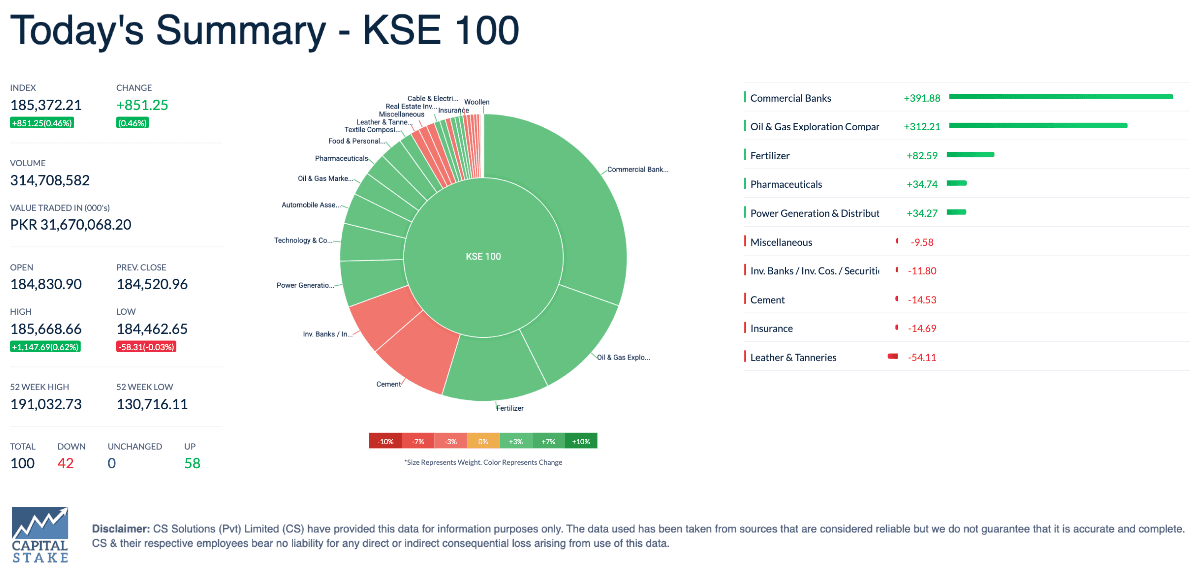
The stock market continued its strong momentum this week, with the KSE-100 Index extending its winning streak to close at 185,372 points, gaining 5,801 points or 3.23% over the week. Investor sentiment remained positive throughout the sessions, largely supported by easing global oil prices and improving expectations around Pakistan’s macroeconomic stability. The de-escalation in US-Iran geopolitical tensions helped Brent crude prices soften to nearly $71.8 per barrel, easing concerns around Pakistan’s import bill and inflation outlook. The rally also reflected growing optimism around improving foreign exchange reserves, potential credit rating upgrades, and stronger participation in key sectors as investors continued rotating back into the market.
Credits: StockIntel
Govt formally transfers management control of PIA to Arif Habib-led consortium
The government formally transferred management control of PIA to the Arif Habib-led consortium this week, marking the completion of one of Pakistan’s most significant privatization transactions in recent years. The move is expected to reduce the financial burden of the loss-making national carrier on the government while opening the door for operational restructuring, efficiency improvements, and potential long-term investment into the airline.
FUNDS IN VIEW
Mutual Funds Regain Momentum as Investors Rotate Back Into Equities
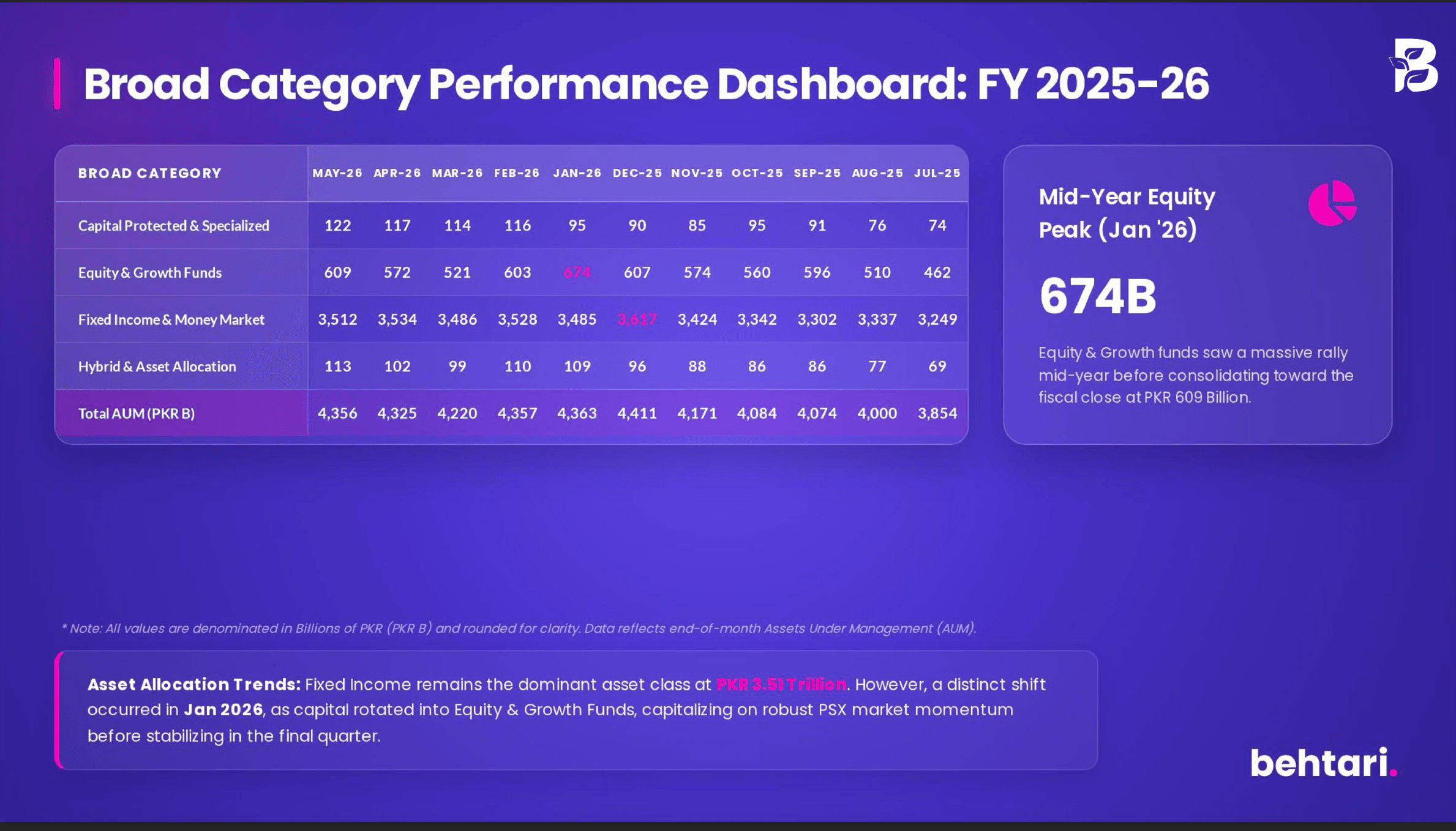
Pakistan’s mutual fund industry closed FY26 with total AUM crossing PKR 4.35 trillion, reflecting steady investor participation despite a volatile macroeconomic environment. While Fixed Income & Money Market funds continued to dominate allocations, Equity & Growth Funds witnessed a strong rally during the middle of the fiscal year, peaking at PKR 674 billion in January 2026 as improving PSX sentiment and easing inflation expectations drove renewed risk appetite among investors.
Credits: Behtari
SECP unveils first ESG Mutual Funds Framework
The SECP introduced Pakistan’s first ESG Mutual Funds Framework this week, allowing asset management companies to launch funds focused on environmental, social, and governance (ESG) investing. The move aligns Pakistan with global sustainable investment trends and could help attract responsible capital while encouraging companies to improve ESG practices going forward.