Pulse
Rates, Risks & Recovery
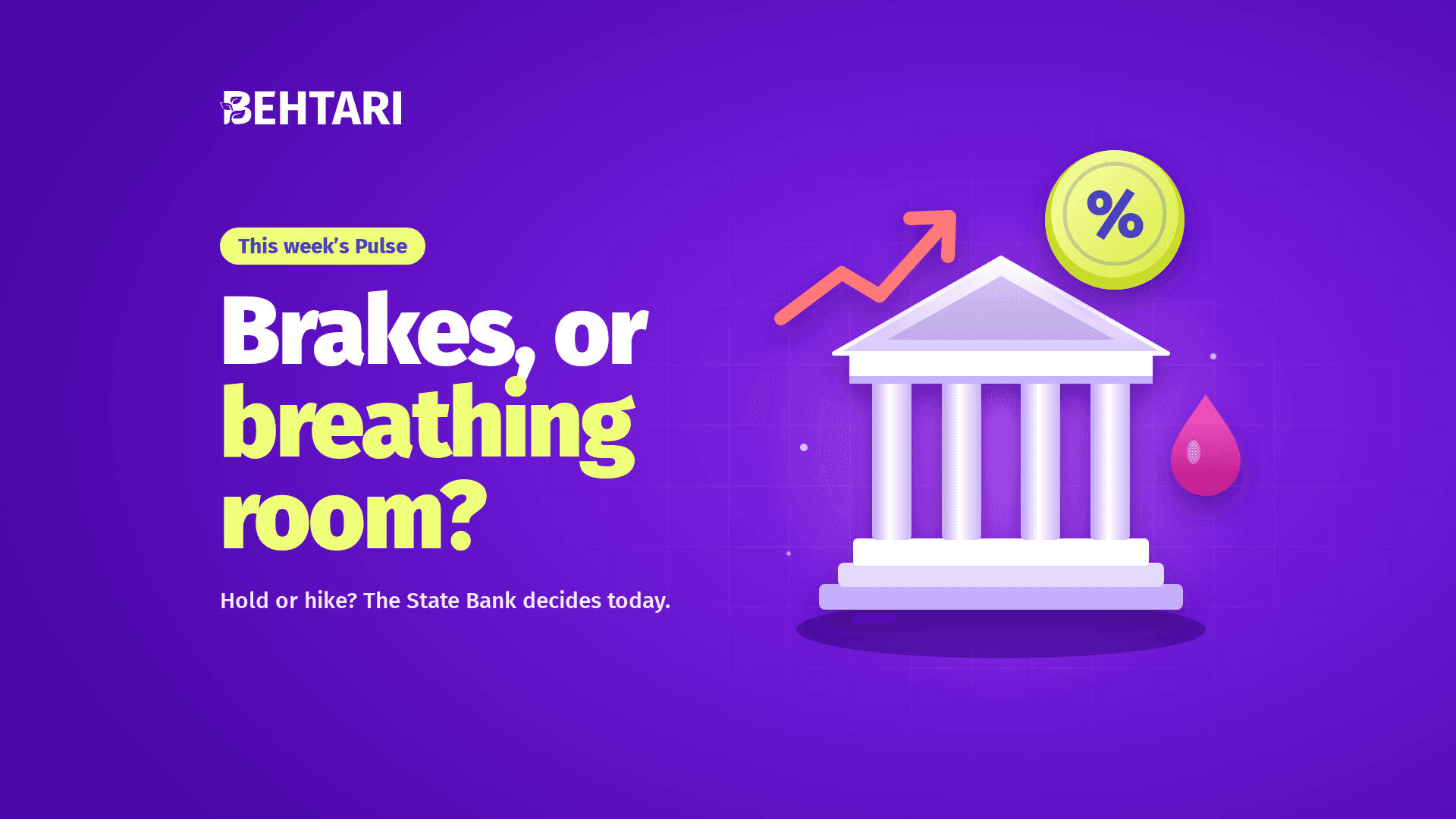
Pakistan faces a crucial rate decision as inflation persists, oil prices climb and stocks slide for a fifth straight week. This week’s Pulse breaks down the economic headlines shaping your money, markets and the country’s road to recovery.
Another Week, Another Pulse!
Pakistan has one big question on its mind today: Will the State Bank hit the brakes on the economy, or give it room to breathe? With inflation climbing and oil prices surging amid tensions in the Middle East, today’s monetary policy announcement could shape borrowing costs, business decisions and financial choices in the weeks ahead.
But interest rates are only part of the story. Pakistan has rejected a $490 million loan over its high cost, trade with Gulf countries is showing signs of improvement, and the government is betting on new policies to boost local industries. Here’s the week’s biggest economic news, and what it could mean for you.
1. Monday's big question: Will interest rates rise?
All eyes are on the State Bank of Pakistan (SBP) as its Monetary Policy Committee meets today, Monday, October 26.
Pakistan's policy rate currently stands at 11.5%, and some economic stakeholders are calling for an increase of 50 to 100 basis points. A 50-basis-point increase would take the rate to 12%, while a 100-basis-point increase would take it to 12.5%. Many market watchers expect a smaller increase, but the decision remains with the SBP.
Why does this matter beyond banks and financial markets?
Higher interest rates can help control inflation by making borrowing more expensive and cooling spending. But they can also raise financing costs for businesses, make loans more expensive and discourage investment. Keeping rates lower could support economic activity, but may make it harder to contain inflation if prices continue to rise.
The challenge is finding a balance between controlling prices and allowing businesses and the economy to grow.
2. The Middle East conflict is becoming an economic problem
The conflict involving Iran, Israel and the United States is not just a geopolitical story. For Pakistan, it could mean a more expensive energy bill.
Oil prices climbed sharply on Friday, with Brent crude reaching $116.72 per barrel, its highest settlement since April. Renewed Houthi attacks on Saudi Arabia and fears of disruptions to energy supplies added to market concerns.
Pakistan is particularly exposed because it imports much of the oil it needs. Its crude oil imports rose by around 12% to 2.78 million tonnes in July–September, compared with 2.48 million tonnes in the same period last year.
When international oil prices rise, Pakistan can face a larger import bill, putting pressure on foreign exchange reserves and potentially pushing up transport, electricity and production costs. Those costs can eventually reach consumers.
The diplomatic and security situation remains uncertain. Iran's foreign minister has said that a possible resumption of war with Israel and the United States would not change Iran's position. US President Donald Trump has also raised the possibility of further military action.
Meanwhile, reports indicate that Washington is pressing Pakistan to restrict land trade routes with Iran as it seeks to extend pressure on Tehran beyond a naval blockade.
The economic risks extend across the region. The International Monetary Fund (IMF) has warned of a sharp contraction in economic output across the Middle East and North Africa, including Pakistan, this year because of the conflict and its effects on energy production, trade and shipping. It projects a potential rebound to 6.6% regional growth in 2027, provided conditions improve, while warning that further energy disruptions could worsen the outlook.
For Pakistan, the concern is clear: higher oil costs and regional instability could make an already difficult fight against inflation even harder.
3. Pakistan needs financing, but not at any price
Pakistan has turned down a proposed $490 million commercial loan from the Islamic Development Bank Group, citing high interest rates.
The decision comes as the country's gross financing needs are estimated at around 20% of GDP. In other words, Pakistan needs substantial funding to meet its financial obligations, but expensive borrowing can add to the pressure in the years ahead.
At the same time, the economy is growing, but not particularly quickly.
The government has revised its estimate of GDP growth for the outgoing fiscal year 2025–26 slightly down to 3.65%, reflecting a mild slowdown in the industrial and services sectors.
The World Bank expects Pakistan's economy to grow by 3.8% in FY27, with inflation at 8.2%. It has also forecast growth of 4.2% in the year before the 2029 general election, while stressing the importance of maintaining macroeconomic stability during an election year.
These forecasts point to a gradual recovery rather than a sudden economic take-off.
The IMF has raised another concern: Pakistan's external financial position could weaken as imports rise and remittances moderate. It has called for exchange-rate flexibility to help preserve foreign exchange reserves and tighter monetary policy to contain inflation.
There was one positive development on the reserves front. SBP-held foreign exchange reserves increased by $19 million to $21.49 billion in the week ended October 16. However, one week's increase does not remove the broader pressure on Pakistan's external finances.
The IMF has also called for a fairer, more neutral tax system to improve compliance and allow businesses to expand. The debate is important because a tax system seen as unfair can discourage investment and make it harder to bring more people and businesses into the formal economy.
The bigger challenge is not simply finding money to finance the economy. It is finding a sustainable way to fund growth without creating even greater financial pressure later.
4. Inflation is still hitting household budgets
The pressure is not limited to oil markets or government finances. It is showing up in everyday prices, too.
Pakistan's Sensitive Price Indicator (SPI), which tracks the prices of essential goods, rose by 0.65% in the week ended October 22. Year-on-year inflation measured by the index reached 11.85%, according to the Pakistan Bureau of Statistics.
That means the cost of the basket of goods tracked by the index was higher than it was a year earlier. Individual prices vary, but the figure helps explain why households continue to feel pressure on their budgets.
Rising energy costs could add to that pressure if they feed into transport, food distribution and the cost of producing goods.
This is part of the dilemma facing the State Bank: it needs to consider the risk of inflation accelerating further, while also recognising that higher interest rates can slow economic activity.
5. Trade offers a small reason for optimism
Not every economic indicator moved in the wrong direction.
Pakistan's trade deficit with Gulf countries narrowed by 26.35% to $2.85 billion in the first quarter of FY27, down from $3.87 billion a year earlier. The improvement was driven by lower imports and moderately higher exports.
A smaller trade deficit means the gap between what Pakistan buys from and sells to these partners has narrowed. That is encouraging, although it does not mean Pakistan has solved its wider trade imbalance.
The government is also looking to strengthen domestic production and exports through its proposed Auto Policy 2026–31. Prime Minister Shehbaz Sharif has approved the draft policy, which aims to increase competitiveness, support local manufacturing, encourage electric vehicle adoption and target $6 billion in auto exports.
If implemented effectively, the policy could help build local industrial capacity and create opportunities for manufacturers and suppliers. But the export target will depend on investment, competitive production costs, reliable infrastructure and demand from international buyers.
The government is also preparing to introduce an Asset Performance Management System, referred to in reports as an Advanced Power Management System, in phases. The initiative aims to improve power management, tackle electricity theft and support better load management.
These plans point to a common goal: improving the systems that businesses depend on, from manufacturing to electricity supply. The real test will be whether the policies deliver measurable improvements.
6. AI could create growth, but who will benefit?
Artificial intelligence is often presented as a major opportunity to boost productivity and economic growth. International officials, including representatives of the IMF and the Organisation for Economic Co-operation and Development, have warned that its benefits may not be shared equally.
Countries with reliable electricity, strong digital infrastructure and skilled workers are better placed to take advantage of AI. Smaller businesses, younger workers and poorer countries could fall behind if they lack access to those essentials.
For Pakistan, this creates both an opportunity and a challenge. AI could help businesses work more efficiently and create new services, but technology alone will not guarantee broader economic gains. Access to power, affordable connectivity and relevant skills will matter just as much.
The question is not only how quickly AI develops, but whether Pakistan can build the foundations needed to benefit from it.
📅 Key Events to Watch!
📆 October 26, 2026💵 Monetary Policy Announcement
📆 October 29, 2026💵 Foreign Exchange Reserves Update
📆 October 30, 2026🛒 Weekly Sensitive Price Index (SPI) Release
Note: These dates are tentative and subject to change.Credits: Pulse by Capital Stake
STOCK MARKET
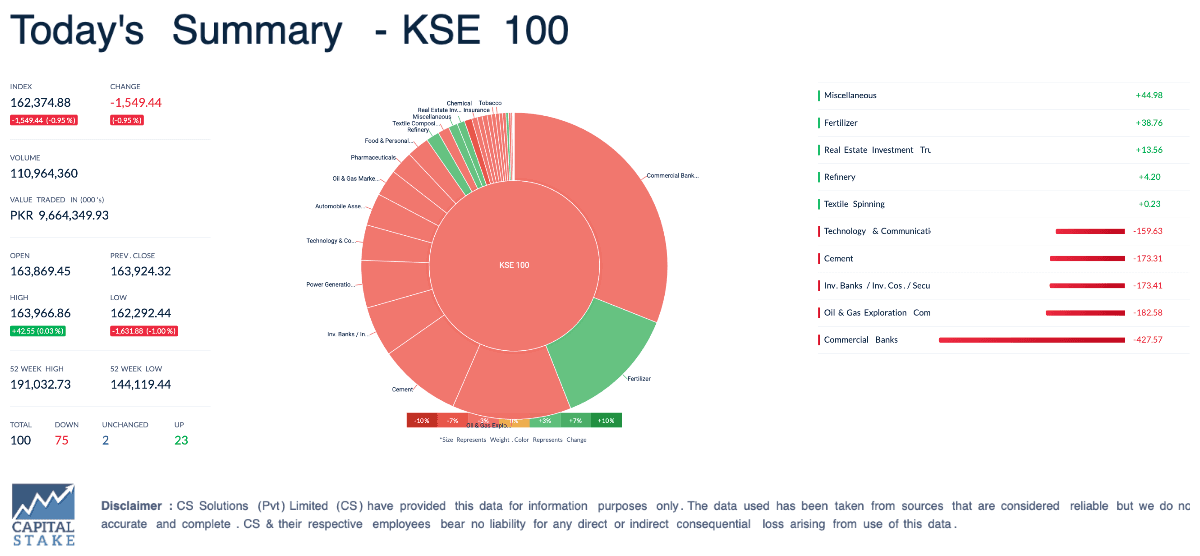
Investors had little reason to celebrate this week as the Pakistan Stock Exchange extended its decline for a fifth consecutive week. The KSE-100 index lost 4,045 points, or 2.4%, to close at 162,375, falling below the key 166,000, 164,000 and 163,000 levels along the way.
A mix of rising oil prices, escalating tensions in the Middle East and uncertainty over Pakistan's economic outlook kept investors on edge, triggering widespread selling. With the State Bank's monetary policy decision due on Monday, market participants are also weighing whether interest rates will rise and what that could mean for businesses and the wider economy.
The key question now is whether the market can regain its footing or whether uncertainty will keep investors cautious.
Credits: StockIntel
What to watch next
This week, three developments deserve particular attention:
Today's monetary policy decision: Will the SBP raise rates to respond to inflation risks, hold steady, or signal a different path?
Oil prices and regional tensions: Any further disruption could raise Pakistan's import costs and complicate its inflation outlook.
The growth-versus-stability balance: Pakistan needs to manage inflation and external financing pressures while creating conditions for stronger investment, exports and job creation.
The coming weeks will reveal how these pressures translate into policy decisions and market movements.
For now, Pakistan's economic story is about navigating competing priorities. Controlling inflation matters, but so does growth. Protecting foreign exchange reserves matters, but so does making room for businesses to invest and expand.
The real challenge is finding a way to make the economy more stable without making growth harder to achieve.