
Pulse
🏦 Reserves 💸 Remittances 📈 Investment

This week, Pakistan’s economic picture offered a mix of resilience and pressure, while geopolitical tensions continued to keep markets on edge. Strong remittances and reserves provided some support, but rising inflation, circular debt and regional uncertainty remain key risks for the weeks ahead.
Another Week, Another Pulse!
While Pakistan celebrated Independence Day and enjoyed a long weekend, tensions continued to build across the Middle East and several important economic developments emerged at home.
The Middle East remains firmly in focus. The Strait of Hormuz continues to be a major pressure point, with traffic through the critical waterway remaining unusually low as Iran and Oman hold talks over reopening it. With ships still facing a difficult and uncertain route, global markets will continue to keep a close eye on oil prices and shipping activity. Meanwhile, fighting in Yemen has intensified, with Yemeni government forces reporting 181 attacks against Houthi rebels in just 24 hours. Houthi attacks also forced a strategic Red Sea port to suspend operations, adding further pressure to already disrupted global shipping routes.
Diplomatic efforts are continuing alongside the conflict. Jared Kushner, a key figure in the Trump administration’s Middle East diplomacy, is expected to meet Hamas leadership in Egypt as part of efforts to push forward a Gaza ceasefire plan. The US military is also facing the consequences of prolonged deployments, with concerns growing over the mental health and morale of personnel aboard the USS Abraham Lincoln after extended time at sea.
Back home, Pakistan’s economy delivered a mixed but broadly encouraging set of signals. Weekly inflation increased by 0.15% during the second week of August, taking the annual inflation rate to 9.11%. While inflation remains a concern for households, other numbers offered more reasons for optimism.
Pakistan’s foreign exchange reserves increased by $23.7 million during the week ending August 7, reaching $22.5 billion. Remittances also started the new fiscal year strongly, with overseas Pakistanis sending home $3.63 billion in July — 13% more than the same month last year and 4.5% higher than June. For families that rely on money from abroad, and for the country’s external finances, this is an encouraging start to FY27.
The government also recorded a third consecutive annual primary budget surplus, reaching Rs3.6 trillion in FY26. Higher petroleum levy collections and tighter control over spending helped improve the fiscal position. However, the bigger debt picture remains challenging: federal government debt, excluding IMF loans and certain other liabilities, reached Rs83.6 trillion by June, up 75% over four years.
The power sector remains another major challenge. The government has added another Rs364 billion to the circular debt burden because of inefficiencies, lower recoveries by distribution companies and payment disputes involving K-Electric. This came despite Rs302 billion in subsidies, highlighting just how difficult it remains to resolve the sector’s long-running problems.
Petroleum also remained in the headlines. The government agreed to revise petroleum dealers’ margins after the Pakistan Petroleum Dealers Association postponed its planned nationwide strike. At the same time, Pakistan’s petroleum exports reached a record $939 million in FY26, up from $903 million the previous year. The government is also moving ahead with refinery upgrades, shifting responsibility for signing and monitoring brownfield refinery agreements from OGRA to the Petroleum Division.
There was some positive news for consumers and businesses as well. Automobile sales jumped around 80% year-on-year in July, giving the new financial year a strong start for the auto industry, even though sales declined compared with the previous month.
Meanwhile, transport disruptions could be easing. An eight-day strike by truckers and edible-oil tankers caused congestion to build up at Karachi’s ports, but talks between the government and transporters could bring the disruption to an end. Any prolonged closure would have risked further delays to imports and exports, so a resolution will be important for businesses in the coming days.
Pakistan’s capital markets are also evolving. The Securities and Exchange Commission of Pakistan has developed a dedicated Shariah-compliant brokerage segment, with around 33 brokerage houses now operating dedicated Shariah-compliant windows. Together, these represent around 52% of total traded volume at the Pakistan Stock Exchange — a sign of just how significant demand for Shariah-compliant investing has become.
On Independence Day, State Bank Governor Jameel Ahmad said Pakistan had made important progress towards economic stability over the past year, pointing to more disciplined fiscal and monetary policies. But the message was also clear: stability is not the finish line. Continued reforms will be needed to turn recent improvements into sustainable economic growth.
On the political front, Jamaat-e-Islami began another round of protests and sit-ins in Karachi, Lahore, Peshawar and Quetta, focusing on the petroleum levy, fuel prices and inflation. Any escalation could add another layer of uncertainty for businesses and consumers already dealing with higher costs.
So, what should we watch this week?
Oil and shipping remain the big global stories. Any movement around the Strait of Hormuz, Gaza ceasefire negotiations or attacks in the Red Sea could quickly affect oil prices, shipping costs and, eventually, prices at home.
In Pakistan, inflation, the rupee, foreign exchange reserves and remittances will remain important indicators of economic health. At the same time, the government’s handling of circular debt, petroleum pricing and the transport strike will tell us a lot about whether recent economic stability can be maintained.
For investors, the bigger picture is becoming increasingly interesting. Pakistan is showing signs of improved external stability, stronger remittances, healthier fiscal numbers and growing participation in capital markets. But high debt, inflation, energy-sector inefficiencies and regional geopolitical risks remain significant challenges.
The takeaway for the week ahead? The economy may be moving in the right direction, but the road is far from smooth. As always, the smartest move is to stay informed, look beyond the headlines and understand what the numbers actually mean for your money.
📅 Key Events to Watch!
📆 August 20, 2026 💵 Foreign Exchange Reserves Update
📆 August 21, 2026 🛒 Weekly Sensitive Price Index (SPI) Release
Note: These dates are tentative and subject to change. Credits: Pulse by Capital Stake
STOCK MARKET
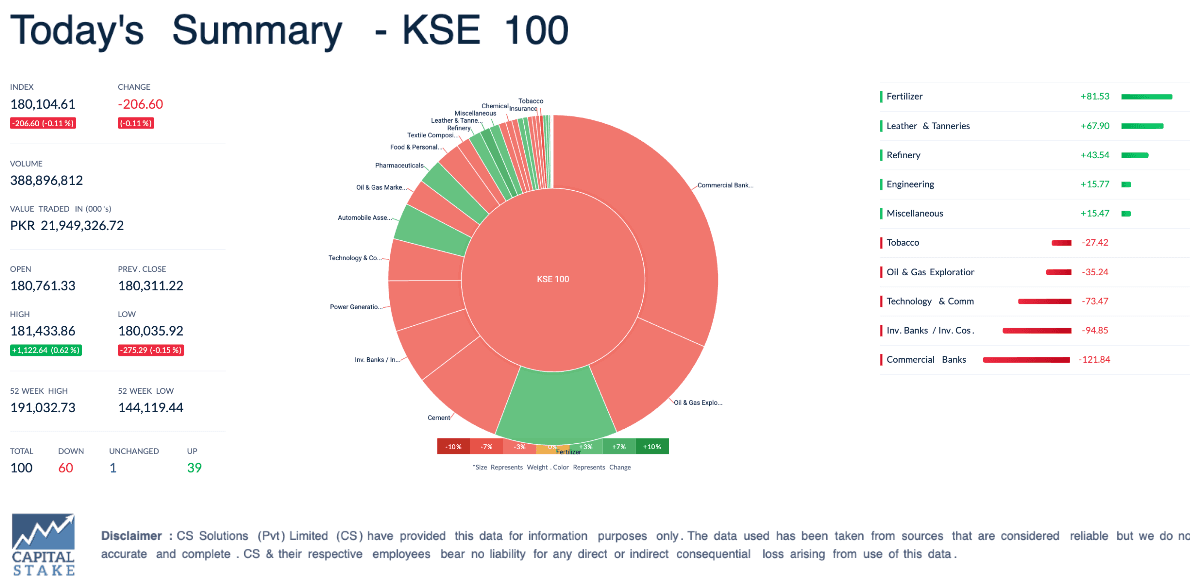
The stock market closed the week in negative territory, with the KSE-100 Index ending at 180,104 points, down 1,325 points, or 0.73%. Trading remained cautious as investors weighed the uncertainty surrounding the US-Iran conflict and the lack of clarity over a lasting cessation of hostilities. The geopolitical uncertainty kept sentiment subdued and limited risk-taking across the market.
Credits: StockIntel
Morgan Stanley Reshuffles Pakistan Stocks:
MSCI has reshuffled Pakistan’s frontier-market small-cap index, with Air Link Communication set to replace Biafo Industries after trading closes on August 31. The change gives Air Link greater visibility among international investors who follow MSCI benchmarks, while Biafo could see less interest from funds tracking the index. For the broader market, however, the impact is expected to be limited.
SECP approves IPO of Agro Processors & Atmospheric Gases Limited
SECP has approved the IPO of Agro Processors & Atmospheric Gases, which plans to offer 58 million shares, representing 15% of the company after listing, on the Pakistan Stock Exchange. The company will use around 40% of the proceeds to expand its edible-oil refining capacity, while also investing in storage and renewable-energy businesses. The IPO comes as Pakistan’s primary market gains momentum, giving investors another opportunity to participate in a new listing while providing the company with capital to fund its expansion.
FUNDS IN VIEW
Floods bring destruction, but they also create urgent demand for the materials needed to rebuild. In our latest Behtari Memo, we look at how sectors such as fertilizers, cement and energy can benefit from this recovery cycle — and what their presence in diversified equity funds can tell investors about navigating economic shocks. Read “The Investment Hiding in the Mud” to explore the investment case.