
Pulse
Security Tensions, Rising Bills & a Market in the Red
From tensions at home and across the Gulf to rising living costs, IMF developments and a weekly dip at the PSX, here’s what shaped Pakistan’s week and what to watch next.
Another Week, Another Pulse!
Missiles near Riyadh airport. An emergency in Khyber Pakhtunkhwa. And grocery bills that keep climbing. Pakistan’s week brought security concerns at home and abroad, a $1.2 billion IMF agreement, and fresh pressure on household budgets. Here's what happened and what to watch next.
1.Security: Tensions Rise at Home and Abroad
Pakistan declared an emergency in Khyber Pakhtunkhwa after President Asif Ali Zardari approved the federal cabinet’s recommendation. The decision came amid political tensions and protests, raising fresh questions about provincial governance and security.
Meanwhile, King Khalid International Airport in Riyadh came under attack. Saudi authorities reported a deadly strike that killed 12 people and injured more than 300, followed by another projectile hitting a passenger terminal. Air defences also intercepted a cruise missile near the airport, according to the Saudi-led coalition.
2. The Economy: IMF Funding Moves Closer
Pakistan reached a staff-level agreement with the International Monetary Fund (IMF) on $1.2 billion in financing. The agreement requires steps including phasing out fuel subsidies, improving social and health spending, and strengthening governance at state-owned companies. The IMF has also proposed changes to state-owned enterprise laws before releasing the next $1 billion tranche.
Meanwhile, Pakistan’s foreign exchange reserves rose by $15 million to $21.454 billion in the week ending October 2. Remittances reached $3.59 billion in September, up 12.7% year-on-year but down 1.9% from August.
3. Your Wallet: Inflation and Bills Remain a Burden
Weekly inflation remained close to 12% year-on-year in the week ending October 8, with flour, chicken and petrol among the pressures. Flour prices rose by an average of Rs14 per kilogram over three days.
Electricity bills are also set to increase, with NEPRA notifying an additional Rs1.11 per unit in October bills due to higher fuel costs. The adjustment is expected to cost consumers around Rs16 billion collectively. Meanwhile, cement prices have risen by as much as Rs201 per 50kg bag over the past year, adding to construction costs.
4. Taxes: Salaried Pakistanis Continue to Carry a Heavy Load
Salaried individuals have paid Rs144 billion in income tax this fiscal year, Rs90 billion more than the combined amount reported for the retail and real estate sectors. The disparity comes as the IMF-backed programme has endorsed a 50% reduction in real estate taxes and a fixed-tax scheme for retailers.
The Federal Board of Revenue (FBR) has proposed allowing late tax filers to join the Active Taxpayers’ List without paying the prescribed surcharge. Separately, Finance Minister Muhammad Aurangzeb said the government is working to simplify tax procedures and bring more retailers into the tax system.
Meanwhile, debt owed by state-owned companies reached a record Rs10.1 trillion by December 2025, highlighting continuing concerns about governance and public finances.
5. Investment: New Money, But Is It Reaching People?
Gulf investors are showing greater interest in Pakistani domestic bonds amid the US-Iran conflict, attracted by relatively high yields. However, higher returns do not mean an investment is risk-free.
The government reported that housing, SMEs, agriculture and electric vehicles received around Rs222 billion in financing during July–September 2026, although data gaps make it difficult to assess how effectively funds are reaching these sectors.
Affordable housing highlights the challenge: banks have approved over Rs400 billion in housing finance, but only around Rs76 billion, or 19%, has reached first-time homebuyers. The government has also approved first-loss coverage to help SMEs and small farmers access financing.
Elsewhere, the Special Investment Facilitation Council (SIFC) is facilitating a 250-acre special economic zone in Gilgit-Baltistan to attract investment, create jobs and develop local industries.
6. Energy and Exports: Expanding Pakistan’s Production
Pakistan’s nuclear electricity generation rose 3.7% to a record 22.5 terawatt-hours in 2025, while solar generation expanded even faster. At the same time, the Phase III expansion of the Thar Block II coal mine increased annual production capacity from 7.6 million to 11.2 million tonnes.
The government is also planning to expand livestock exports by importing higher-yield animal breeds, establishing specialised farms and restructuring the sector with private-sector expertise.
7. Cars and Industry: Policy Changes Ahead
Pakistan’s automotive policy for 2026–31 is nearing completion. The draft plans to address imports, local manufacturing, tariffs, electric vehicles and safety standards, with reported tax incentives and financing support for electric and other new-energy vehicles.
Separately, the government has increased additional customs duties on imported tyres and motorcycle parts that are also produced locally, aiming to support domestic manufacturers.
What to Watch Next Week
Security: Further developments in KP and the regional conflict.
The economy: Progress towards the next IMF disbursements and any new programme conditions.
Your money: Changes in food prices, electricity costs and tax rules.
Business: Whether financing schemes, automotive incentives and investment plans move from announcements to implementation.
That’s your Pulse for the week. Stay informed, keep your finances in perspective, and remember: what gets announced matters, but what actually gets implemented matters more.
📅 Key Events to Watch!
📆 October 15, 2026💵 Foreign Exchange Reserves Update
📆 October 16, 2026🛒 Weekly Sensitive Price Index (SPI) Release
Note: These dates are tentative and subject to change. Credits: Pulse by Capital Stake
STOCK MARKET
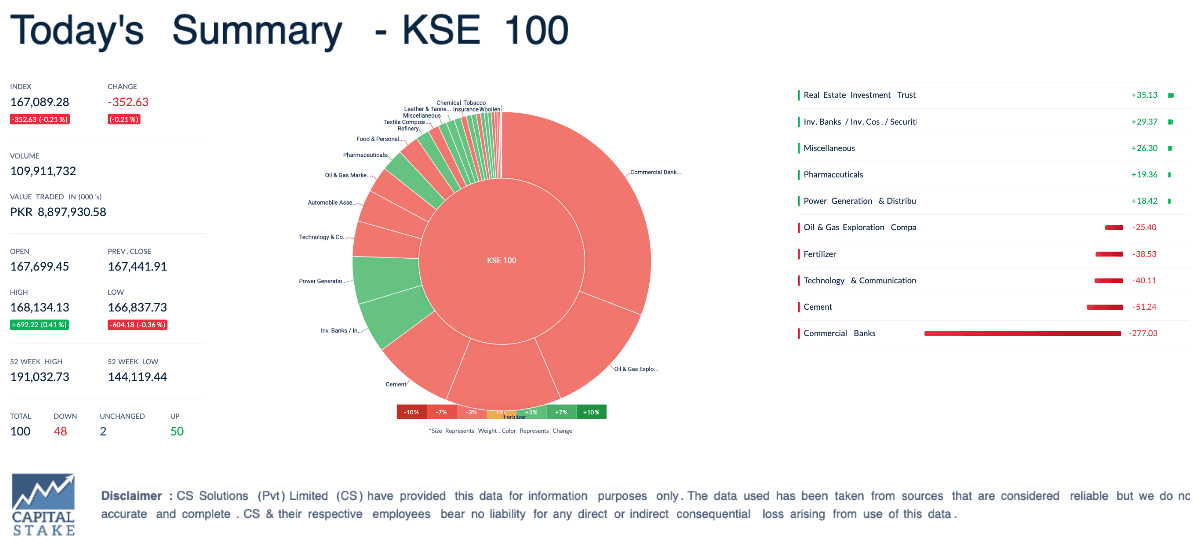
The Pakistan Stock Exchange ended the week in the red, with the benchmark KSE-100 Index falling more than 350 points on Friday to close near 167,090. The decline brought its weekly loss to 0.69%, as geopolitical uncertainty, high international oil prices and concerns over Pakistan’s widening trade deficit weighed on investor sentiment.
Credits: StockIntel