Pulse
🌍 Tensions ⛽ Inflation 📊 Markets
Global tensions, rising oil prices, a market correction, record remittances, and key economic reforms—here's everything that moved Pakistan's markets and economy this week.
Another Week, Another Pulse!
If there was one word to describe this week, it would be uncertainty.
Just when markets had begun to settle into a relatively stable rhythm, tensions in the Middle East returned to dominate headlines. A sharp escalation between the United States and Iran reignited fears of a wider regional conflict, sending investors back into risk-off mode and putting oil prices firmly back in focus. For Pakistan, that's never just international news—it's something that can directly impact inflation, fuel prices, and the overall economy.
The biggest concern remains the Strait of Hormuz. Following exchanges of missile and drone attacks, Iran once again threatened the strategic waterway through which nearly a fifth of the world's oil supply passes. Any disruption here has an immediate effect on global energy markets. Oil traders hate uncertainty, and even the possibility of supply disruptions is often enough to push prices higher. For countries like Pakistan that rely heavily on imported fuel, expensive oil quickly translates into higher import costs, pressure on the rupee, and eventually higher prices at the petrol pump.
That impact was already visible this week as the government increased petrol prices by Rs. 13.18 per litre and high-speed diesel by Rs. 13.80 per litre. While no one welcomes higher fuel prices, they're a reminder of how events thousands of miles away can end up affecting everyday life at home. Rising transport and logistics costs eventually find their way into food prices, manufacturing costs, and overall inflation.
Speaking of inflation, there were early signs that prices are beginning to edge higher again. Pakistan's Sensitive Price Index (SPI), which measures short-term inflation, rose 11.94% year-on-year for the week ending July 9. The increase was driven largely by higher prices of perishable food items, wheat flour, and fuel. While headline inflation has come down considerably over the past year, the latest figures suggest that inflation risks haven't disappeared, particularly if oil prices continue climbing.
Despite these challenges, there was encouraging news on Pakistan's economic front. The World Bank approved $375.9 million to help modernize Pakistan's electricity transmission system under the Grid Stability Enhancement Project. Reliable electricity may not grab headlines like oil prices or stock markets, but it's one of the biggest long-term requirements for economic growth. A stronger transmission network means fewer power disruptions, better integration of renewable energy, and a more efficient power sector—all of which are essential if Pakistan wants to improve industrial productivity and attract new investment.
Another bright spot came from overseas Pakistanis, who once again demonstrated their importance to the economy. Workers' remittances reached an all-time high of $41.58 billion during FY2025-26. At a time when many emerging economies are struggling to secure foreign exchange, Pakistan continues to benefit from the steady support of millions of Pakistanis working abroad. These inflows help strengthen foreign exchange reserves, support the rupee, and provide an important cushion for the country's external account.
International financial institutions, however, remain cautiously optimistic rather than overly enthusiastic. The Asian Development Bank revised Pakistan's growth forecast down to 3.7%, while the International Monetary Fund maintained its projection at 3.5% for the current fiscal year. More importantly, the IMF highlighted the growing risks posed by geopolitical tensions, warning that prolonged instability in the Middle East could push commodity prices higher and complicate Pakistan's economic recovery. It's a reminder that while domestic reforms matter, global events can still shape Pakistan's economic trajectory.
On the fiscal side, the government's debt continued its upward climb, reaching Rs. 82 trillion by the end of May. Borrowing itself isn't unusual—every government borrows—but what matters is how efficiently those funds are used and whether economic growth can outpace the increase in debt over time. Pakistan's audit authorities have called for stronger oversight to ensure future borrowing remains aligned with genuine financing requirements rather than becoming a recurring burden.
Interestingly, while government debt continues to grow, borrowing costs are moving in the opposite direction. The government successfully raised over Rs. 2 trillion through the latest Treasury Bill auction, with yields across all maturities continuing to decline below the policy rate. Falling yields generally indicate that investors expect inflation and interest rates to remain relatively stable over the medium term. Lower borrowing costs also make it easier for businesses to invest and expand, something equity investors typically welcome.
The government is also exploring new ways to finance itself. Plans are underway to introduce Hybrid Sukuk Bonds for the first time in Pakistan, allowing the government to diversify its funding sources while expanding the country's Islamic capital market. At the same time, authorities have announced plans to return to international capital markets through fresh Eurobonds, Sukuk, and Pakistan's first dollar-settled, rupee-linked bonds. If market conditions remain favourable, these issuances could improve Pakistan's external financing profile and reduce refinancing risks over the coming years.
There was also encouraging activity within Pakistan's capital markets. According to the Securities and Exchange Commission of Pakistan (SECP), 21 listed companies collectively raised more than Rs. 20 billion during the last fiscal year to fund expansion plans, increase production capacity, and invest in new projects. Companies generally don't raise fresh capital unless they see opportunities for growth, making this a healthy sign for the broader economy.
The government also appears keen to revive Pakistan's automobile sector. A new Auto Policy is expected to be announced next month with the aim of attracting fresh investment, encouraging local manufacturing, and creating a more competitive market. While the details are still awaited, the industry will be watching closely to see whether the policy can attract new players and increase domestic production.
So, what should investors watch in the coming week?
The answer remains the same as it was this week: oil.
If tensions between the United States and Iran continue to escalate, oil prices are likely to remain volatile, putting pressure on inflation across the world, including Pakistan. At the same time, investors will be looking for signs that Pakistan's improving external position—supported by record remittances, multilateral financing, and stronger capital markets—can continue to offset some of these global headwinds.
Markets rarely move in a straight line. Some weeks are driven by corporate earnings, others by economic data, and occasionally by geopolitics. This was one of those weeks where events beyond our borders shaped sentiment more than anything happening at home. Yet beneath the global uncertainty, Pakistan's economy continues to show gradual signs of stability. The challenge now is maintaining that momentum while navigating an increasingly unpredictable global environment.
STOCK MARKET
Pakistan's stock market finally took a breather after weeks of record highs. The KSE-100 Index fell 3,130 points (1.69%) during the week to close at 182,242, as escalating tensions between the United States and Iran triggered a wave of profit-taking. While the geopolitical uncertainty weighed on investor sentiment, the decline appears to be more of a short-term reaction than a shift in market fundamentals. Investors will now be closely watching developments in the Middle East and oil prices, both of which could influence market direction in the coming weeks.
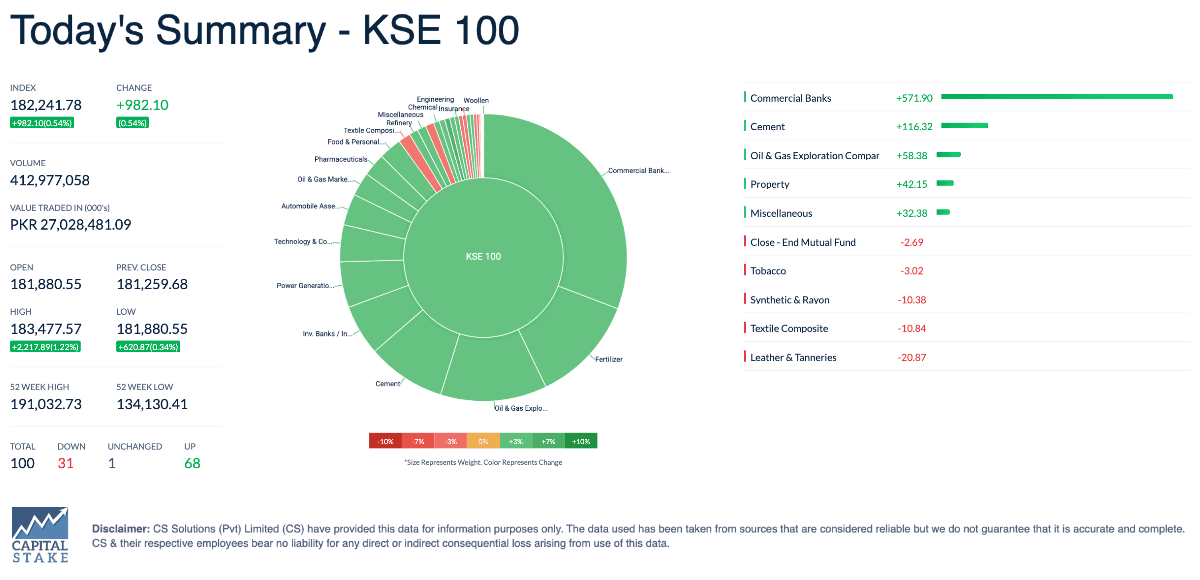
Credits: StockIntel
SECP introduces IBAN digital verification
The SECP has introduced IBAN-based digital verification, allowing financial institutions to verify customers using their bank account details instead of relying on repeated documentation during the KYC process. The move is expected to make account opening faster, improve the customer experience, and support greater digital adoption across Pakistan's financial sector. Going forward, this could encourage more investors to access regulated financial products while helping institutions onboard customers more efficiently.
FUNDS IN VIEW
Fund Segment Breakdown: Shariah vs. Conventional.
By May 2026, the market has evolved into a balanced ecosystem. Shariah-compliant offerings (49.4%) have experienced remarkable growth, reaching PKR 2.15 Trillion and closely trailing the conventional sector (50.6% at PKR 2.20 Trillion).
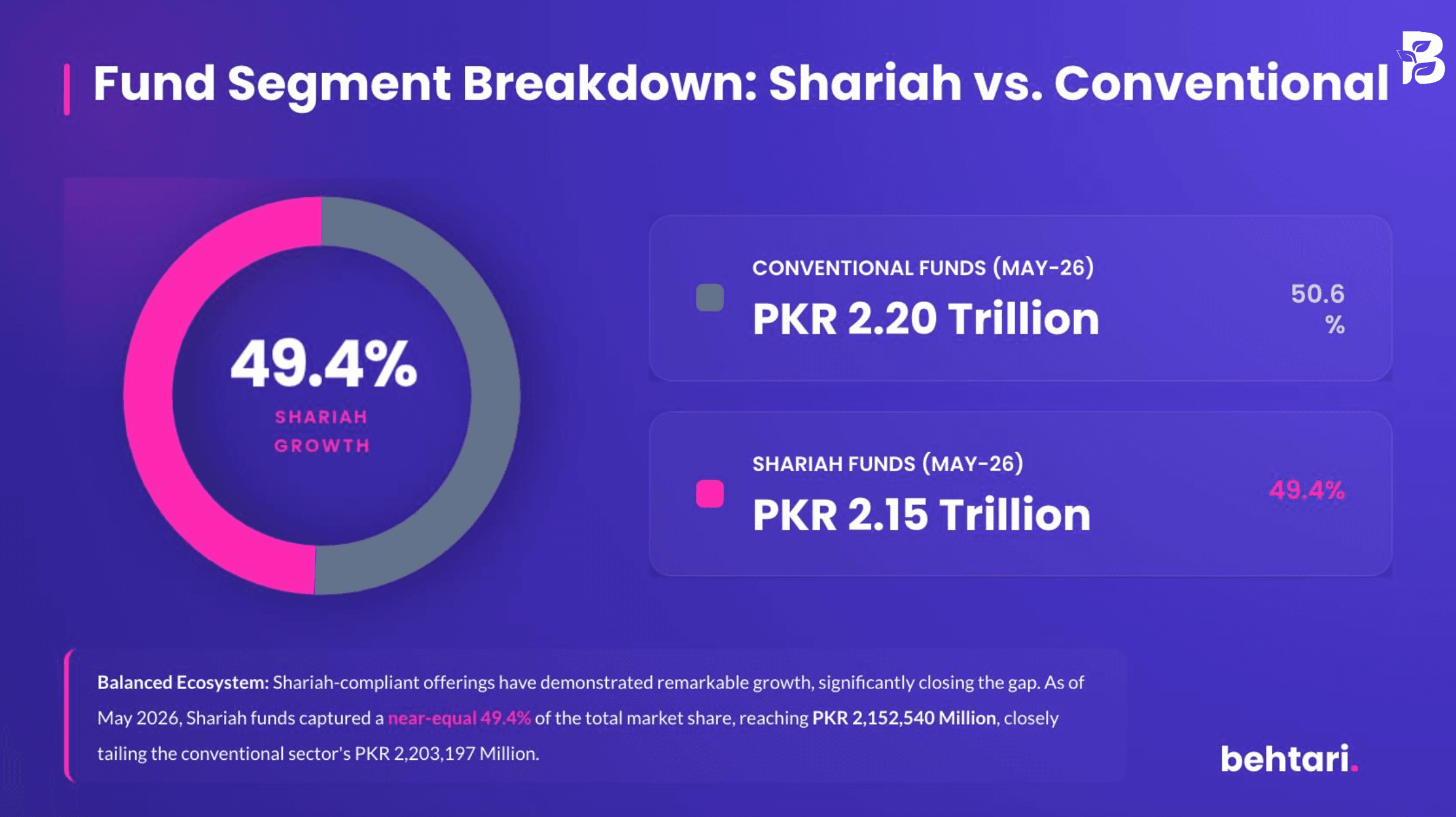
Credits: Behtari