Pulse
The Cost of Uncertainty
A week of rising oil prices, renewed Middle East tensions and pressure on Pakistan’s markets, inflation and government finances, with the SBP rate decision and IMF review now in focus.
Another Week, Another Pulse!
The week is kicking off on a watchful note, with all eyes on the State Bank as its monetary policy decision takes centre stage. With the 11.5% rate in focus, oil prices moving higher and tensions in the Gulf adding to the uncertainty, the IMF’s upcoming biannual review is another big event on the radar. There’s plenty brewing as Pakistan heads into the week.
📅 Key Events to Watch!
📆 September 14, 2026🏦 Monetary Policy Announcement
📆 September 17, 2026💵 Foreign Exchange Reserves Update
📆 September 18, 2026🛒 Weekly Sensitive Price Index (SPI) Release
Note: These dates are tentative and subject to change. Credits: Pulse by Capital Stake
The rate decision everyone is watching
The first big question of the week lands on Monday: what will the State Bank do with the 11.5% policy rate?
Markets are largely expecting the SBP to hold rates steady, but rising oil prices and renewed geopolitical tensions have made the outlook less straightforward. Pakistan’s improving external position gives the central bank some room to wait, while higher energy costs are putting fresh pressure on inflation.
For investors, Monday's announcement is not just about whether rates move. The bigger clue will be what the SBP says about inflation, oil and the months ahead.
Oil is becoming a bigger problem
The Gulf conflict is making an already difficult energy picture more complicated.
Operations at some Saudi energy facilities were halted after Houthi attacks wounded 73 people. Later, Saudi authorities said drones launched from Iraq temporarily closed a key oil export route used to bypass the Strait of Hormuz.
For an oil-importing country like Pakistan, disruptions in the region can travel quickly from the headlines to the household budget.
Higher oil prices can mean higher transport costs, more expensive electricity and greater pressure on businesses. Researchers and analysts are already warning that the prolonged Gulf conflict is making it harder for Pakistan and other regional economies to take clear positions on economic and monetary policy.
Pakistan has responded diplomatically too, with Prime Minister Shehbaz Sharif telling Saudi Crown Prince Mohammed bin Salman that Pakistan would continue efforts to help defuse regional tensions and expressing solidarity with Saudi Arabia.
At home, the government is considering reducing the petroleum levy to Rs5–10 per litre and replacing around Rs1.45 trillion in annual revenue through new taxes, reduced exemptions, spending cuts and better enforcement.
The government is also moving ahead with refinery upgrades. The Petroleum Division has finalised the plant upgrade agreement for the country’s existing refineries and sent it to the ECC for approval, paving the way for implementation of the amended Pakistan Oil Refining Policy for Upgradation of Existing/Brownfield Refineries, 2023.
The oil industry is pushing back against further changes to the pricing formula, warning that they could disrupt fuel supplies, hurt refinery throughput and make the operating environment increasingly difficult for oil marketing companies and refineries.
So the oil story is no longer just about what happens at the pump. It could influence inflation, interest rates and government finances too.
Inflation is creeping back into the conversation
Pakistan’s Sensitive Price Indicator rose 8.62% year-on-year in the week ending September 10, up from 8.35% a week earlier.
Fuel and cooking-gas prices were the main drivers, more than offsetting lower prices for some perishables.
Electricity is adding to the pressure. NEPRA has increased electricity prices by Rs0.52 per unit under the quarterly adjustment mechanism, the second consecutive electricity price increase in a week.
That makes the inflation picture worth watching closely. Even as some of Pakistan's broader economic indicators improve, higher energy costs can quickly make life more expensive for households and businesses.
And this is exactly the backdrop against which the SBP is making its monetary policy decision.
The dollar picture is looking better
There is some welcome news on Pakistan’s external position.
Liquid foreign exchange reserves have crossed $23 billion, reaching around $23.7 billion as of September 4, helped by government commercial loan proceeds.
Remittances are also keeping up their strong momentum. Overseas Pakistanis sent $7.3 billion in the first two months of FY27, up 14.7% from the same period last year. That follows a record $41.6 billion during FY26.
Roshan Digital Accounts are showing strength as well. Total investment has reached $13.9 billion, while August inflows stood at $259 million, up 58% year-on-year. The number of accounts has crossed 966,000.
The improvement is encouraging, but Moody’s says Pakistan will need to sustain reforms, rebuild reserves and maintain access to financing if it wants further improvement in its sovereign credit rating.
More dollars are coming in, but Pakistan still needs to prove that the improvement is sustainable.
Next stop: the IMF
Just as the SBP decision takes centre stage, another major economic checkpoint is approaching.
An IMF mission is scheduled to begin talks with Pakistan on September 23 for the fourth review under the country's $7 billion Extended Fund Facility and the $1.4 billion Resilience and Sustainability Facility.
The review will cover Pakistan’s economic performance and implementation of commitments for the period ending June 30, 2026.
The timing is important. Pakistan will go into the review with stronger reserves and remittances, but also higher inflation, energy-price risks and continuing pressure to improve government finances.
For markets, the IMF review will be one of the biggest events to watch this month.
The government is looking for revenue. Lots of it.
Pakistan is continuing its push to widen the tax base and raise revenue.
The FBR has launched a simplified tax-return facility for small traders, offering a 1% tax on turnover with a minimum liability of Rs25,000.
At the same time, the salaried class paid Rs91 billion in income tax during the first two months of FY27, compared with Rs28 billion collected from the real estate sector.
The government is also considering replacing a large portion of petroleum levy revenue through new taxes, fewer exemptions, spending cuts and stronger enforcement.
Meanwhile, the power sector continues to absorb enormous amounts of money. The federal government paid Rs2.935 trillion to Independent Power Producers during the first 11 months of FY2025-26.
The gas sector has another cost coming into focus. With utilities facing multibillion-rupee losses following attacks on energy infrastructure, the government is studying a proposal to create 14 dedicated security wings to protect gas pipelines and oil and gas exploration companies, particularly in Khyber Pakhtunkhwa and Balochistan.
The estimated cost is Rs46 billion, which would ultimately be recovered from consumers through higher gas prices.
The challenge is becoming clearer: the government needs more revenue and fewer losses, but many of the fixes come with a bill for someone else to pay.
Pakistan is betting on a more digital economy
Beyond rates, oil and taxes, Pakistan is continuing to push ahead with digital and regulatory reforms.
The government has proposed a nationwide digital system for farmers and agricultural land records, including soil and water testing data, as part of efforts to modernise agriculture.
Pakistan is also pushing for clearer rules around digital assets. At the UN, the Minister of State and PVARA Chairman called on countries to move beyond simply discussing digital assets and start building regulatory frameworks for the next generation of global finance.
The government has also approved another $200 million ADB loan for digitalisation, despite concerns raised by the Planning Commission.
Meanwhile, SECP has approved regulatory reforms aimed at improving Pakistan’s performance in the World Bank Group’s Business Ready assessment.
And Pakistan is looking beyond its borders for trade and investment opportunities.
Pakistan and Oman are discussing plans to establish Gwadar Port and Oman’s Sohar Port as sister ports, potentially strengthening maritime connectivity, trade and investment between the two countries.
British International Investment has also identified Pakistan as an important investment destination and plans to expand its presence as part of a strategy to invest at least $2 billion across Asia and Africa from 2026 to 2031.
And there is a potentially interesting corporate conversation ahead: Prime Minister Shehbaz Sharif is expected to meet Apple CEO John Ternus in the United States to discuss the company’s potential entry into Pakistan.
One more thing regulators are watching
As Pakistan and the rest of the world move deeper into digital finance, regulators are also watching the risks that come with it.
The Financial Action Task Force has warned countries about emerging money-laundering and terror-financing risks linked to the rapid growth of online gaming and gambling.
At the same time, the Gates Foundation plans to reach around 170,000 women and 450,000 children in Pakistan this year through a programme combining cash support, nutrition assistance, livelihood training and access to citizen facilitation centres.
These stories sit outside the immediate rate-and-oil conversation, but they point to a broader theme: Pakistan’s economic story is increasingly being shaped by digitalisation, regulation, investment and how effectively reforms reach people.
STOCK MARKET
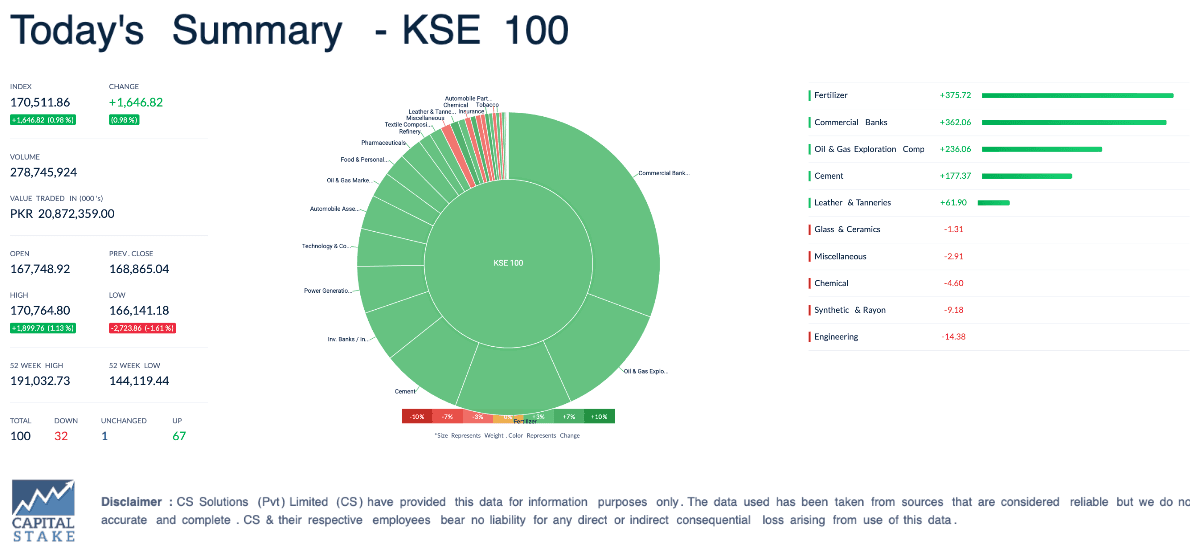
The turbulence in the Middle East also spilled into Pakistan’s stock market. Rising oil prices and renewed geopolitical uncertainty weighed on investor sentiment, sending the KSE-100 down 2.75% over the week. The index lost 4,817 points, closing at 170,512.
Credits: StockIntel
FUNDS IN VIEW
Fund Ranking 🏆 Top 5 Income and Money Market Funds this Week!
ABL Funds leads at 13.05% with ABL Islamic Sovereign Plan I, and Shariah-compliant funds hold the top two spots overall, ahead of the conventional options in the same category.

Compare the returns before you invest. Full list at behtari.com