


Pulse
Markets, Tensions & More
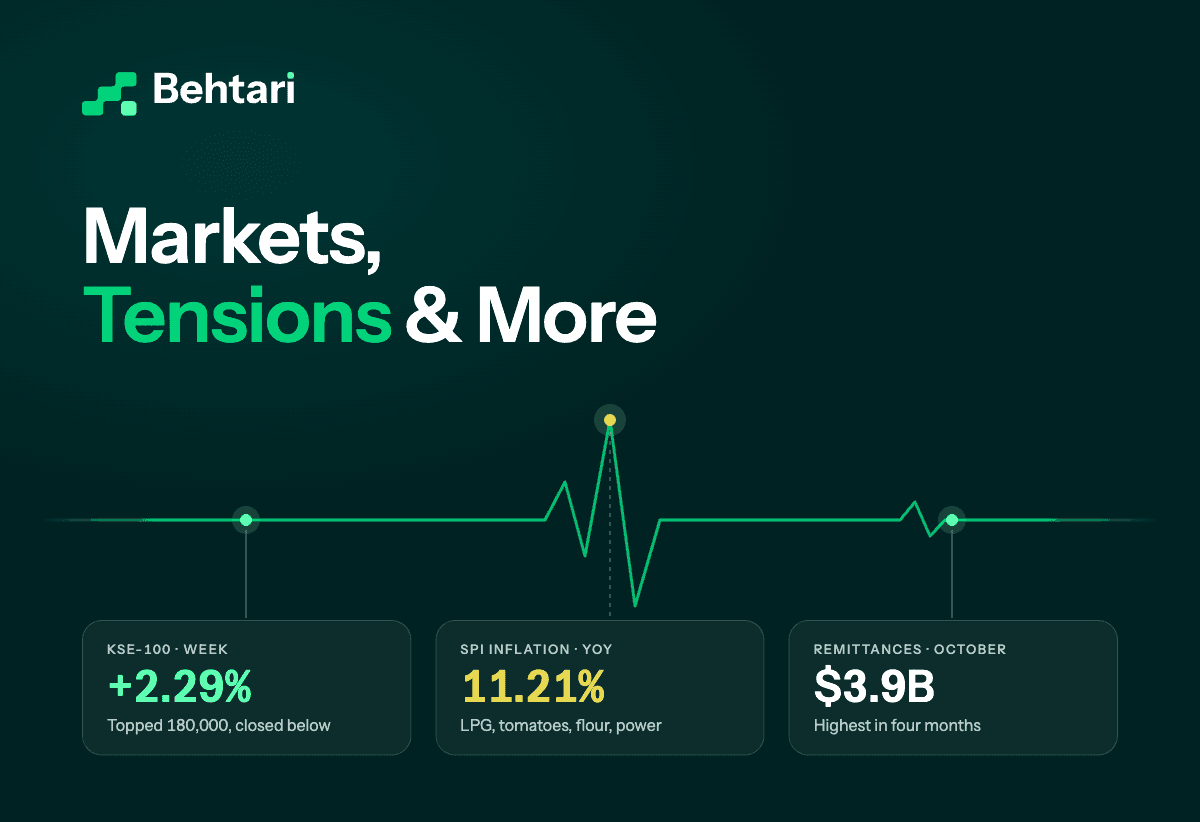
From renewed geopolitical tensions to changing economic conditions, this week brought plenty of developments to keep an eye on. Pakistan's investment scene saw fresh activity, while the stock market posted weekly gains. Here's what made the headlines and what could shape the days ahead.
Another Week, Another Pulse!
It was a week of disruptions, uncertainty and a few encouraging signs. From travel chaos across the United States and renewed tensions in the Gulf to longer power cuts at home, there was plenty to keep an eye on. Meanwhile, Pakistan's economy continued to send mixed signals, with rising prices on one side and growing investment activity on the other.
Let's take a look at what happened and what it could mean for the week ahead.
📅 Key Events to Watch!
📆 November 19, 2026💵 Foreign Exchange Reserves Update
📆 November 20, 2026🛒 Weekly Sensitive Price Index (SPI) Release
Note: These dates are tentative and subject to change.
Credits: Pulse by Capital Stake
Tensions Return to the Gulf
After nearly two months of relative calm, tensions between Iran and the United States are rising again.
Iran's Revolutionary Guards claimed to have launched six drones targeting a US air-defence radar facility at the Al-Rifaa helicopter base in Bahrain early Sunday. Bahrain said it intercepted several aerial attacks before they reached their targets, although neither Bahrain nor the US immediately confirmed Iran's claim that the radar facility had been hit.
The attacks prompted Bahrain to issue public warnings and urge residents to move to safe locations. This was the second reported attempt since Friday, when the US military said it had intercepted two Iranian drones without any damage.
The situation is closely linked to the Strait of Hormuz, one of the world's most important shipping routes for oil. The US has been carrying out strikes on Iranian naval facilities along its southern coast and Qeshm Island to support ships travelling through the waterway. Iran, meanwhile, has warned that vessels passing through without its permission could be targeted, claiming that ships have encountered sea mines in the area.
The tensions are also spreading across the region. In Yemen, the Iran-backed Houthi group is increasing pressure on government forces around Aden, the country's interim capital. Saudi-backed Yemeni forces have reportedly withdrawn from their offensive around Bab el-Mandeb to focus on securing Aden.
The developments are already weighing on regional markets. Most Gulf stock markets ended lower on Sunday as investors assessed the risks of further conflict and disruption to shipping routes.
Global Disruptions
Microsoft Outlook, Teams and other business services also experienced a global outage that lasted around 36 hours before services were restored, disrupting businesses and users who rely on these tools for everyday work.
Travel across the United States was disrupted after a technical issue in the air traffic control system triggered a nationwide ground stop lasting more than four hours. Thousands of flights were cancelled on Saturday, affecting travellers across the US and internationally.
Meanwhile, US President Donald Trump, Chinese President Xi Jinping and Russian President Vladimir Putin are set to hold their first trilateral meeting on November 19 in Shenzhen, China. Nuclear arms control and the ongoing conflict involving Iran are expected to be among the key topics.
Pakistan's Economy: Rising Prices, Debt and Electricity Shortages
Pakistan's economic picture remained mixed this week. While the country made progress on some international commitments, households continued to face pressure from rising prices and electricity shortages.
Pakistan met three major conditions set by the International Monetary Fund (IMF) for the first quarter of the current financial year. These included keeping government spending and borrowing under control.
However, inflation remains a concern. Prices of everyday essentials increased by 11.21% compared with the same period last year, according to the latest weekly figures. Higher prices of LPG, tomatoes, electricity and wheat flour continue to put pressure on household budgets.
Electricity shortages added to the frustration. Several parts of the country experienced increased load-shedding during the week, with Lahore facing power cuts of up to four hours in some areas.
There were some encouraging developments, too. Money sent home by overseas Pakistanis reached $3.9 billion in October, the highest monthly amount in four months. These remittances provide an important source of foreign currency and help support Pakistan's economy. During the first four months of FY2026-27, total remittances reached approximately $14.77 billion, almost enough to cover the country's merchandise trade deficit of $14.6 billion during the same period.
The country's foreign exchange reserves also edged up by $11 million to $21.57 billion during the week ended November 6.
On the other hand, Pakistan's total debt and liabilities reached nearly Rs98.9 trillion by the end of September, up 6.46% from a year earlier.
Government finances also came under pressure. Pakistan's overall budget surplus fell from 1.7% to 0.9% of GDP during the first three months of the financial year compared with the same period last year. The government had less money left over after accounting for its spending. Lower revenue collection compared with the size of the economy and smaller cash surpluses from provincial governments contributed to the decline.
The Centre also received only Rs57.5 billion, or 6% of its annual provincial grant, for national economic initiatives.
Taxes, Government Spending and International Funding
Pakistan is making several changes to how it collects taxes, manages public spending and attracts international financing.
The government plans to draw the full $1.7 billion available under a World Bank financing programme aimed at widening the tax base and aligning government spending with constitutional responsibilities.
However, the programme has faced implementation challenges. The World Bank has twice rated progress on its approved $600 million tranche as moderately satisfactory, while the government has reportedly breached one of the programme's conditions twice.
After 17 years, the government has also decided to separate the collection of sales tax and income tax, reversing an earlier arrangement. The decision comes amid a sales tax collection gap of Rs3.4 trillion, highlighting how much revenue the government is failing to collect.
The IMF has meanwhile renewed its call for Pakistan to gradually phase out fuel subsidies for motorcyclists, rickshaw drivers and small car owners. It wants any future support to be limited, temporary and covered by the government's existing budget.
On the international funding front, the Asian Development Bank has approved up to $500 million in emergency financing to help Pakistan respond to natural disasters.
Pakistan also repaid around $14.44 billion in external loans during the previous financial year, against $16.16 billion received in new external financing. Most of the money received was used for budget support and strengthening the country's foreign exchange position.
There was a change in domestic borrowing, too. The federal government's domestic debt declined significantly during the first quarter of FY2026-27, reversing the trend seen in the previous year. This refers to the movement in domestic borrowing during the quarter, rather than the country's overall debt stock.
Separately, the State Bank of Pakistan increased the threshold for reporting certain cash transactions from Rs2 million to Rs3 million. This means financial institutions must report relevant transactions under the applicable monitoring rules at the revised threshold.
Pakistan's Investment Industry Continues to Grow
Pakistan's investment industry had some encouraging developments this week, particularly in mutual funds and government securities.
The country's mutual fund industry reached nearly Rs4.5 trillion in assets under management during FY2025-26. This reflects the growing amount of money being managed through mutual funds, with both individual investors and institutions participating.
Foreign investors are also showing interest in Pakistan's government debt instruments. Investment in Pakistan Investment Bonds crossed $500 million during the first four months of FY2026-27, while another $238 million flowed into Treasury Bills.
Both are ways for investors to lend money to the government in exchange for returns. Pakistan's relatively high interest rates
Pakistan and Saudi Arabia have launched a joint private equity fund through their business council. The fund is expected to begin with several hundred million dollars, with 75% allocated to investments in Pakistan and the remaining 25% in Saudi Arabia.
Pakistan is also looking to attract foreign investment into its mining sector. The Minerals Investment Forum 2026 in Islamabad brought together participants from more than 60 countries to explore opportunities in the sector.
The auto industry recorded stronger sales as well. Car sales rose 48% to 63,418 units during July–October FY27. In a related development, the government approved a new Auto Policy for 2026–31, targeting $6 billion in exports and encouraging greater local manufacturing of vehicles and auto parts.
STOCK MARKET
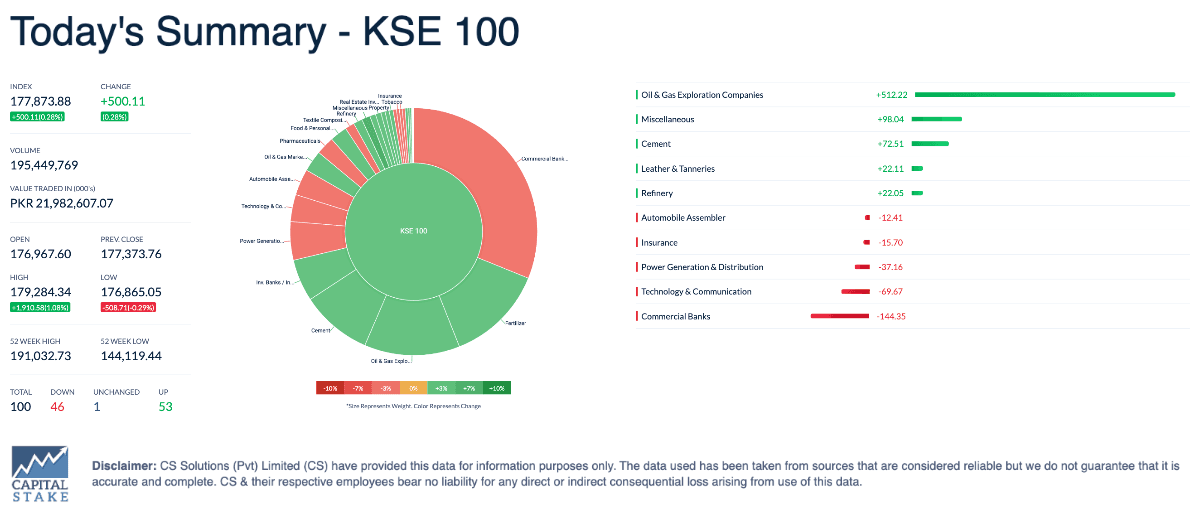
The Pakistan Stock Exchange had a strong week, with the KSE-100 gaining 2.29% despite some ups and downs along the way. The index crossed the 180,000 mark during the week but couldn't hold on to those gains, closing below it on Friday.
Improved investor sentiment, supported by softer oil prices and hopes of easing tensions in the Middle East, helped lift the market. However, profit-taking and domestic political uncertainty limited further gains.
Credits: StockIntel
Morgan Stanley Adds Another Pakistani Company to Its Index
MSCI has added Attock Refinery (ATRL) to its Pakistan Index, taking the number of listed companies in the index to 30 from December 1. Being included in this global market benchmark can increase the company's visibility among international investors and potentially attract more foreign investment into its shares. However, Pakistan's overall share in the broader MSCI Frontier Markets Index has actually declined from 5.2% to 4.98%, showing that the country's addition of another company does not necessarily mean its overall market position has improved.