

Pulse
Oil, Rates & Market Jitters
A week of rising interest rates, petrol price disputes, stock market swings and fresh investment efforts, as global tensions keep oil markets on edge. Catch the key developments shaping Pakistan’s economy and what to watch next.
Another Week, Another Pulse!
As smog continues to blanket cities across the country, making daily life increasingly difficult, the week brought plenty of other developments worth following. Petrol pricing is under pressure, interest rates have climbed, and Pakistan is looking abroad for billions in investment. Meanwhile, tensions between the US and Iran are keeping the Strait of Hormuz and global oil supplies firmly in focus.
Here’s what happened last week, and what it could mean for the days ahead.
1. Borrowing just got more expensive
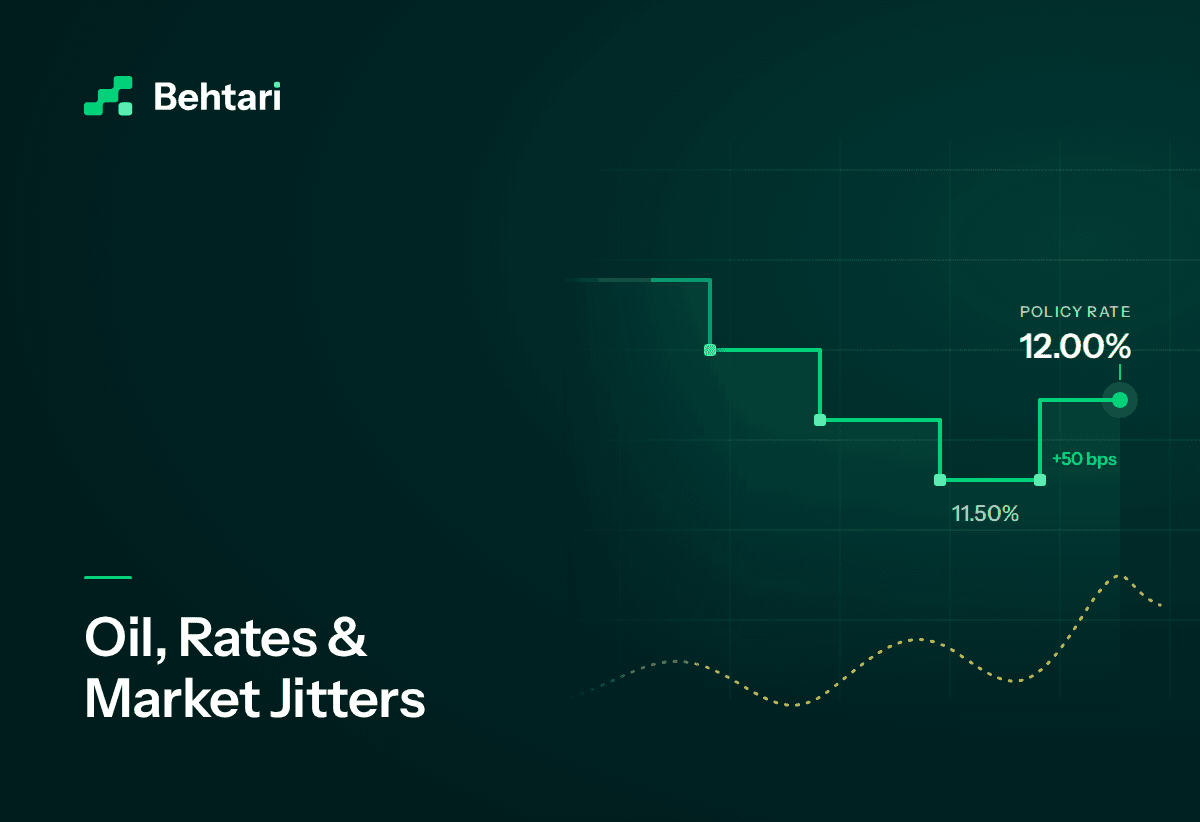
The State Bank raised its policy rate by 50 basis points to 12%, reversing the recent period of monetary easing. The decision comes as pressure from energy and food prices threatens to keep inflation elevated.
The move could make borrowing more expensive for businesses and households. Economists have warned that higher financing costs may discourage private investment, slow job creation and weigh on economic growth.
Meanwhile, weekly inflation stood at 11.32% for the week ending October 29, although it edged down 0.35% compared with the previous week. Gold prices in Pakistan also fell on Friday, following a decline in international markets that took gold to its lowest level in a year.
For households, the combination of higher interest rates and persistent price pressures means the cost of living remains a concern.
2. Petrol pricing is back in the spotlight, while electricity bills may get a rethink
The government has introduced a temporary change to the petrol pricing mechanism, but the decision has sparked resistance from local refineries.
Under the new arrangement, refineries are required to surrender the difference between the import price and the calculated ex-refinery price to the government through the Petroleum Levy account. The estimated burden on refineries is around Rs49 per litre of locally refined petrol. Separately, the government has adjusted the petroleum levy calculation by Rs14.71 per litre.
Refineries have objected to the arrangement, saying it was introduced without consultation and could force them to sell below production cost. They have also raised concerns about the impact on investment in refinery upgrades.
There may, however, be some relief on electricity bills. Power Minister Awais Leghari told the Senate that the government has decided to scrap the electricity slab system that penalises consumers for crossing the 200-unit threshold, even by a single unit. The government plans to move towards targeted subsidies for consumers who need them most.
3. Pakistan is looking for investment from Saudi Arabia, the US and beyond
Pakistan is making another push to attract foreign investment, with energy, minerals and infrastructure among the key areas of interest.
Talks with Saudi Arabia focused on expanding cooperation in oil storage, refinery upgrades, crude oil and LPG procurement. Pakistan has also offered Saudi companies tax-free facilities to store oil in the country, potentially allowing them to build commercial reserves. Agriculture, minerals and mining were also part of the discussions.
Separately, Pakistan has sought investment from US financial institutions to upgrade its oil refineries and expand cooperation in the energy sector.
The government is also preparing a private equity framework aimed at attracting between $10 billion and $15 billion in tax-neutral investment from domestic and international investors.
The proposals point to a broader effort to bring in private capital. The challenge will be turning these discussions and investment targets into projects that actually get off the ground.
4. More financing for small businesses, but the wider economic picture remains mixed
There are some encouraging signs in business financing. Financing to small and medium-sized enterprises (SMEs) has more than doubled, rising from Rs491 billion in June 2024 to around Rs1,110 billion in June 2026. The number of SME borrowers also increased from 177,000 to 325,000.
The State Bank has announced another step to widen access to credit: the limit for collateral-free SME loans has been raised from Rs10 million to Rs50 million. This could make it easier for smaller businesses to access financing without having to pledge assets.
Pakistan's foreign exchange reserves also increased by $33 million to $21.52 billion in the week ending October 23.
But the numbers are not all moving in the right direction. The FBR collected Rs4.06 trillion in the first four months of the fiscal year, falling Rs124 billion short of its target. Meanwhile, Pakistan's trade deficit with nine neighbouring countries widened by 26.62% to $4.97 billion in the first quarter of FY2026-27, compared with $3.93 billion a year earlier.
The State Bank has also raised the minimum capital requirement for locally incorporated banks to Rs20 billion. Existing banks and development finance institutions have until December 31, 2030, to meet the new requirement.
5. US-Iran tensions keep the Strait of Hormuz in focus
Efforts to bring Washington and Tehran back to the negotiating table continue, with Qatar and other mediators working behind the scenes. Iran has reportedly viewed a message from US Vice President JD Vance positively and is considering a response, although it remains deeply sceptical of President Trump's intentions.
Trump has said negotiations are going well, but also made clear that he is in no hurry to reach a deal. Tehran, meanwhile, has warned that it can inflict serious damage on US warships and that any ground invasion would face fierce resistance.
One development worth watching is the Strait of Hormuz. Iran says the key shipping route could reopen within two days under a plan discussed with Qatari mediators, provided the US accepts its conditions. Any progress here could have consequences for global oil supplies and prices.
The tensions are not limited to Iran. Yemeni government forces say they shot down two Houthi drones in Taiz and intercepted a ballistic missile launched towards the country's southern region.
For now, the situation remains uncertain, and any escalation could quickly affect energy markets.
6. A major crypto hack puts exchange security under scrutiny
Binance, one of the world's largest cryptocurrency exchanges, has been working to contain what it described as a complex attack involving around $6.3 billion in funds. The exchange says roughly half of the affected funds have been frozen to prevent further theft.
The incident has prompted other crypto exchanges to strengthen their security measures and call for greater information-sharing across the industry.
The episode is another reminder that even large, established platforms are not immune to cyberattacks, and that security remains a major concern for anyone dealing in digital assets.
7. Pakistan takes a bigger role in global economic discussions
Pakistan has assumed the chairmanship of the G-24, a group of developing countries that works to strengthen their voice in international financial discussions.
Separately, the government has raised the threshold for currency transactions that banks must report as suspicious to the Financial Monitoring Unit by 50%, taking it to Rs3 million. The change is part of the country's anti-money laundering framework.
📅 Key Events to Watch!
📆 November 2, 2026 📊 CPI Inflation
📆 November 5, 2026 💵 Foreign Exchange Reserves Update
📆 November 6, 2026 🛒 Weekly Sensitive Price Index (SPI) Release
Note: These dates are tentative and subject to change.
Credits: Pulse by Capital Stake
STOCK MARKET
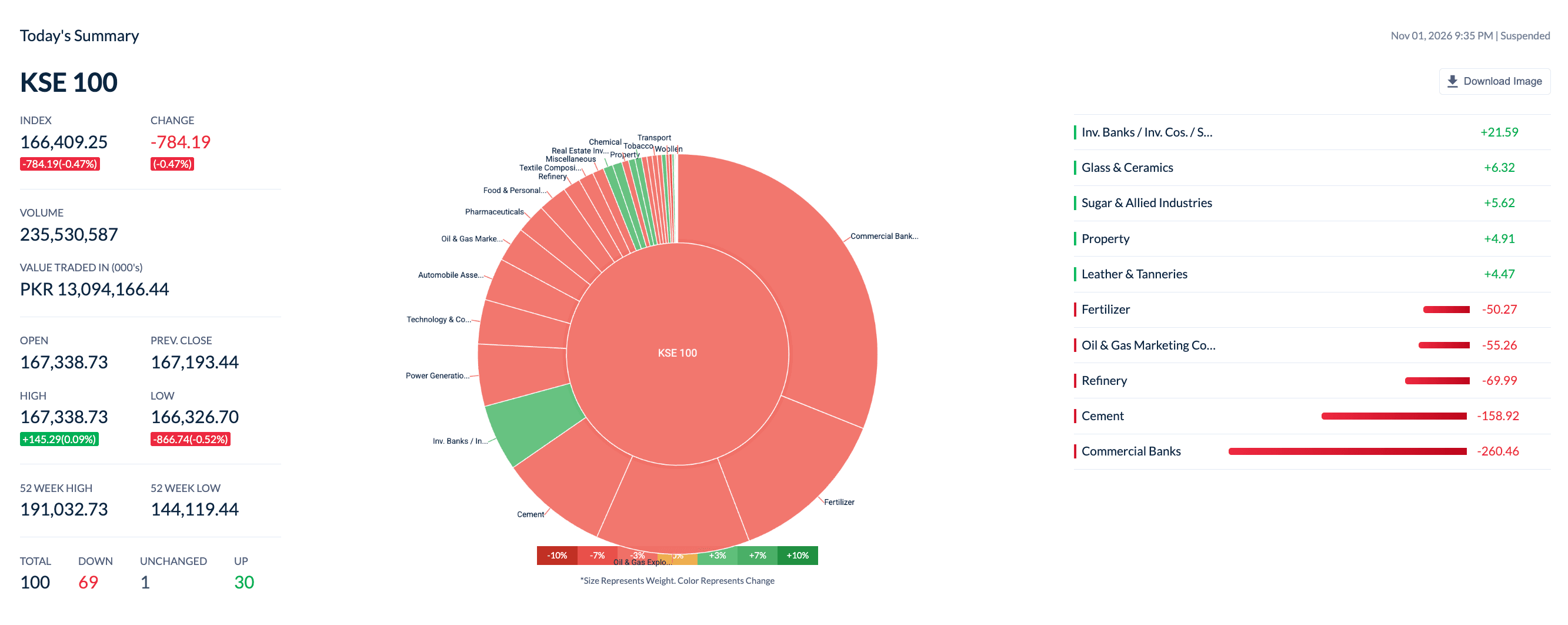
The KSE-100 fell 2.1% in October, shedding 3,560 points to close at 166,409. The index recovered more than 4,800 points over four sessions towards the end of the month, briefly crossing 167,000, but Friday's profit-taking erased some of those gains.
Rising oil prices, foreign investor outflows and uncertainty over US-Iran tensions, including reported attacks on tankers in the Strait of Hormuz, weighed on sentiment.
Credits: StockIntel
What to keep an eye on this week
Whether the US and Iran make progress towards an agreement, particularly on the Strait of Hormuz.
How the new petrol pricing arrangement affects consumers and local refineries.
Whether the State Bank's rate increase puts further pressure on borrowing and business activity.
Whether Pakistan's investment discussions with Saudi Arabia and the US move towards concrete commitments.