


Pulse
📊 Budget 🏛️ Inflation 📈 Markets 📊
A packed week ahead as Pakistan moves closer to the federal budget, with key inflation data, reserve updates, and SPI readings shaping the macro outlook. Markets remain supported by strong sentiment, while global and domestic developments continue to influence the direction of economic policy and investor confidence.
Another Week, Another Pulse!
As the country eased back into routine after the Eid break, the news cycle picked up immediately. At the center of attention is Pakistan’s upcoming federal budget, set to be announced on June 5. The government is working with a proposed size of Rs17.1 trillion for FY27, targeting GDP growth of 4.1% and inflation around 8.4%. While these numbers suggest stability, what really matters is how they will affect everyday expenses.
Taxation is expected to play a major role. The government, along with recommendations from the International Monetary Fund, is considering raising the standard GST rate to 19%. Solar panels, which have become a popular alternative to rising electricity costs, may also see GST increased from 10% to 18%. This could slow down the shift toward solar energy at a time when adoption was accelerating. Additional sector-specific taxes on energy and transport are also being discussed, which may ultimately raise the cost of living.
There is some potential relief under consideration for salaried individuals. The government is reviewing options that could include absorbing up to Rs200 billion to ease the tax burden. Public sector employees and retirees may see salary and pension increases, while a Defined Contributory Pension system is being explored, particularly for the armed forces, as part of longer-term reforms.
Fuel prices offered some immediate relief this week, with petrol and high-speed diesel reduced by Rs22 per litre. While this provides short-term comfort, the broader inflation outlook will depend heavily on budget decisions and global factors. In parallel, Pakistan LNG Limited has taken a step toward energy security by inviting international firms to study the development of strategic petroleum reserves.
On the international front, Pakistan strengthened its economic engagement with China. Agreements worth more than $7 billion were signed between Pakistani and Chinese companies during engagements in Hangzhou. Prime Minister Shehbaz Sharif also reaffirmed commitment to the next phase of the China-Pakistan Economic Corridor, focusing on industrial cooperation and investment. This reflects a continued push to position Pakistan as a regional hub for manufacturing and partnerships.
At the same time, certain domestic pressures are building. Fertilizer prices, especially DAP, have risen sharply to around Rs16,000 per bag due to costly international shipments. This could have a direct impact on agriculture and food prices in the coming months.
There was a modest improvement in external accounts as well. Pakistan’s foreign exchange reserves held by the State Bank increased slightly to $17.147 billion, offering some stability, though the rise remains gradual.
Globally, markets remained volatile. Tensions involving Iran led to sharp swings in bond markets, pushing yields to multi-decade highs before easing again on signs of diplomatic progress. These developments matter because they influence global borrowing costs and can directly impact economies like Pakistan.
Closer to home, the investment landscape continues to evolve. Pakistan’s mutual fund industry has grown nearly 6.8 times since 2019, crossing Rs4 trillion in assets. While this shows increasing participation, the heavy concentration in low-risk money market funds is raising concerns about long-term growth and market depth.
Meanwhile, geopolitical tensions in the Middle East intensified. Israeli operations in Lebanon expanded, with Prime Minister Benjamin Netanyahu calling it a significant strategic shift. Lebanese leadership has responded with strong criticism, warning of escalating instability in the region.
Overall, the week reflected a mix of cautious optimism and underlying pressure. With the budget around the corner, global uncertainty in play, and key economic decisions ahead, the coming weeks are likely to shape the direction of both markets and sentiment.
📅 Key Events This Week!
📌 1 June 2026 📊 CPI Inflation Data Release
📌 4 June 2026 💱 Foreign Exchange Reserves Update
📌 5 June 2026 📊 Weekly SPI Inflation Data Release🏛️ Federal Budget Announcement
Credits: Pulse by Capital Stake
STOCK MARKET
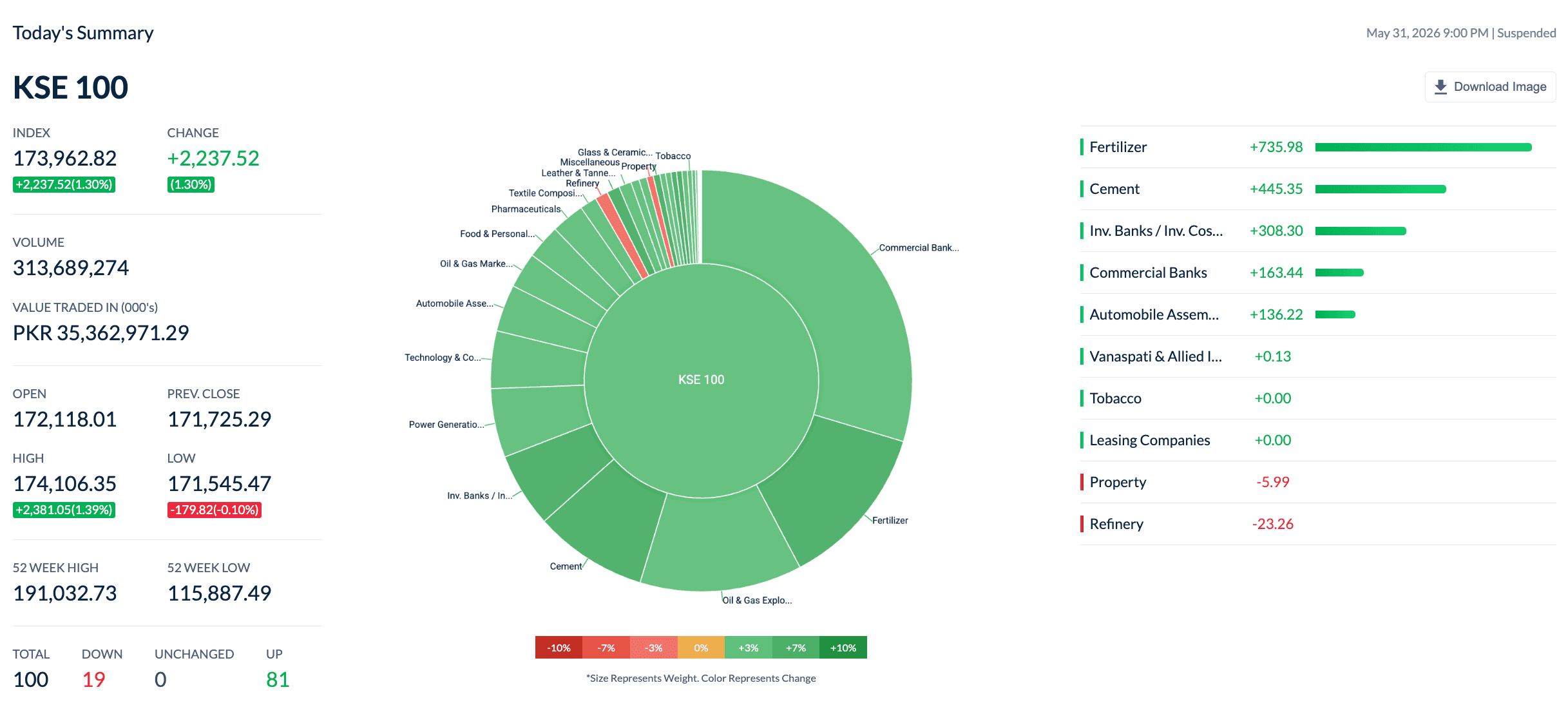
Pakistan’s equity market closed the week on a strong note, with the benchmark KSE-100 Index rising 3.65% week-on-week to settle at 173,963, gaining 6,119 points despite a shortened trading week due to Eid holidays. The rally was largely driven by improved investor sentiment following the extension of the US-Iran ceasefire for 60 days, which eased concerns around potential oil supply disruptions and supported overall market confidence.
Credits: StockIntel
FUNDS IN VIEW
NBP Financial Sector Fund: Banking Sector Momentum in Focus
While equities extended their upward momentum on Friday, the financial sector remained a key driver of market strength. In this context, the NBP Financial Sector Fund stood out with a 1-year return of 82.21%, reflecting sustained participation in the ongoing banking cycle.Fund details: https://behtari.com/mutual-funds/nbp-financial-sector-fund
The performance has been supported by an improving macro backdrop, particularly the rise in policy rates to 11.5%, which has reinforced banking sector profitability through stronger interest spreads and improved earnings visibility across major financial institutions.
A closer look at the fund’s core exposures highlights its alignment with leading banks that have driven sector performance over the period:
MCB Bank: +56.97%
United Bank Limited (UBL): +70.95%
Askari Bank (AKBL): +113.91%
These names reflect the breadth of participation within the banking space, where earnings momentum has been uneven but directionally strong across key players.
While individual stocks within the sector have, at times, delivered outsized returns, those outcomes have been highly stock-specific and dependent on timing and positioning within a rapidly evolving market cycle.
The fund structure addresses this by maintaining diversified exposure across the leading banking universe, allowing participation in sector-wide upside while reducing reliance on any single outcome. This positions the portfolio to stay aligned with broader financial sector momentum rather than concentrated single-name risk.